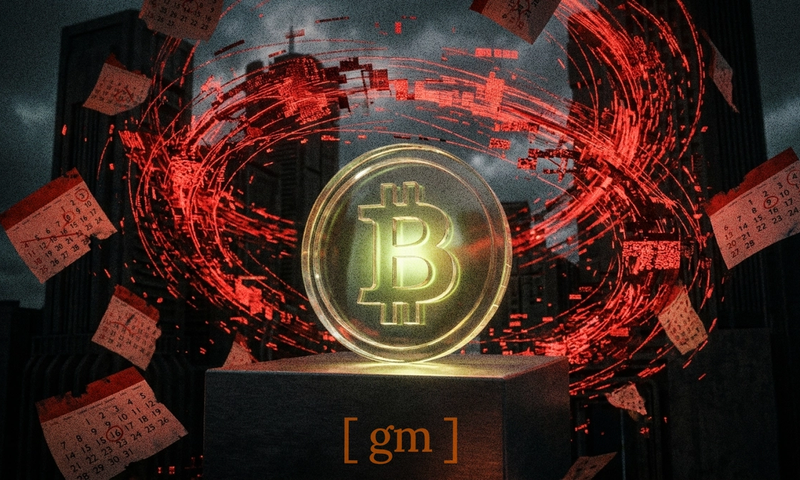
For a few tense days, crypto braced for disaster. A weekend flash crash across Bitcoin, Ethereum, and AI-linked futures revived fears of a "Black Monday", a catastrophic market collapse, timed ominously to the anniversary of history's most infamous one-day crash. Crypto Twitter lit up with doom. And then... it didn't happen. Bitcoin held above $82,000, shrugging off the panic. Here's what sparked the fear, why October 19 carried such weight, and what the non-event reveals about crypto's relationship with its own anxieties.
What sparked the fear
The panic began over the weekend. Bitcoin, Ethereum, and perpetual futures tied to AI and semiconductor stocks experienced abrupt price swings, with one report estimating nearly $34 million in AI-related liquidations. Perpetual contracts linked to chip companies including Micron, SanDisk, and SK Hynix saw sharp declines while US stock exchanges were closed, a reminder that crypto-based "stock perpetuals" trade 24/7 even when Wall Street is shut.
The moves themselves were modest in hindsight, Bitcoin briefly fell about $1,000 before recovering, and Ethereum dipped from around $2,420 to $2,360 before bouncing back toward $2,410. But coming after a brutal stretch where Bitcoin had fallen below $80,000, the weekend volatility was enough to set nerves on edge heading into Monday.
Why October 19 carried such weight
The date is what supercharged the fear. October 19, 2026 marked the 39th anniversary of the original Black Monday, October 19, 1987, when the Dow Jones Industrial Average plunged 22.6% in a single session, still the largest one-day percentage drop in its history. For traders steeped in market history, a weekend wobble landing right on that anniversary was irresistibly ominous.
Blockchain analytics firm Santiment reported a substantial rise in "Black Monday" discussions across crypto social media, with chatter about an imminent crash surging across Crypto Twitter. The fears were amplified by genuine headwinds: rising oil prices, expectations of higher interest rates, weakening stock-market breadth, and spot Bitcoin ETFs that had been bleeding money (roughly $228 million in net outflows the prior week).
Why the crash didn't happen
Despite all the doom, Monday came and went without catastrophe. Bitcoin finished October 18 near $82,000 and traded around $82,795 on October 19, defying predictions of another major decline. The broader market even showed signs of recovery.
Why did the feared crash fizzle? A few reasons. First, the weekend moves were small, a $1,000 Bitcoin dip is noise, not a crash, and the market quickly absorbed it. Second, much of the "Black Monday" narrative was social-media sentiment rather than a fundamental trigger; there was no new catastrophic catalyst, just an ominous date and jittery nerves. Third, and tellingly, institutional buyers actually stepped in: the same week saw Bitcoin ETFs reverse their outflows and pull in over $1 billion across three sessions, real demand quietly offsetting the retail panic. The anniversary was a psychological focal point, not a market mechanism.
Why it matters
The "Black Monday that wasn't" is a useful lesson in how crypto markets, and the fear that drives them, actually work. Social media can manufacture a crisis narrative out of a modest weekend dip and an ominous calendar date, and that narrative spreads far faster than the fundamentals justify. Santiment's data showing a spike in crash-talk is itself telling: historically, peak fear often coincides with market bottoms, not the start of a collapse, because by the time everyone is screaming "crash," the selling is frequently already done. This episode fits that pattern, the loudest doom coincided with institutional money quietly buying the dip. None of this means crypto is immune to real crashes; the genuine risks (high yields, a hawkish Fed, thin market breadth) remain, and a true shock could still arrive. But the October 19 non-event is a reminder to separate narrative from reality, to be skeptical of viral panic tied to anniversaries and vibes rather than fundamentals, and to remember that in markets, the most-predicted catastrophe is often the one that never comes. Bitcoin didn't have its Black Monday. It just had a bad case of nerves, and got over it.
This is educational information, not financial advice. Crypto is highly volatile; prices cited are as of publication and will change. Always do your own research.