
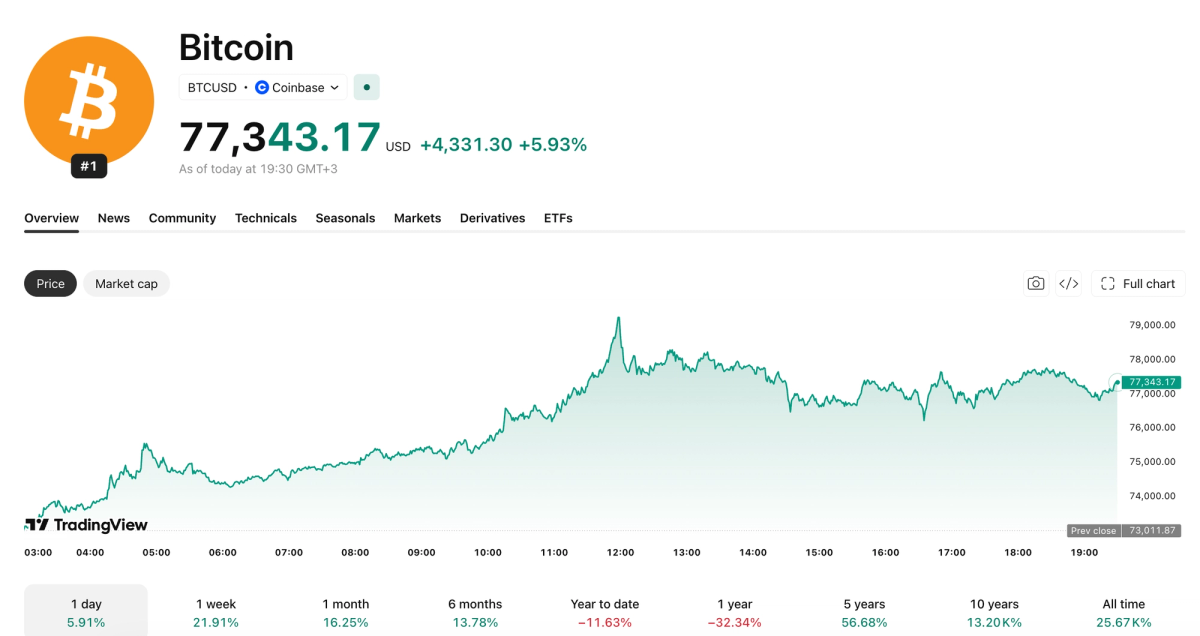
For most of the summer, the crypto market was a graveyard, the quietest phase in years, with traders bracing for a bottom they didn't expect until October. Then, in a matter of days, everything flipped. Bitcoin exploded more than 22% on the week to trade near $77,000-$78,000, Ethereum jumped over 20%, and a technical signal that hasn't appeared since last November lit up green. The question on every screen: is the bull run actually back?
Here's what's confirmed, what's driving it, and why the smartest people in the market can't agree on what happens next.
The signal: Bitcoin's 200-day moving average
The move that has analysts talking is technical. Bitcoin crossed back above its 200-day moving average for the first time since November 2025, roughly a month after it hit an all-time high above $126,000 and began its long slide. The 200-day moving average is one of the most widely watched lines in all of trading, a smoothed measure of the long-term trend. Price above it is traditionally read as a bullish regime; price below it, bearish.
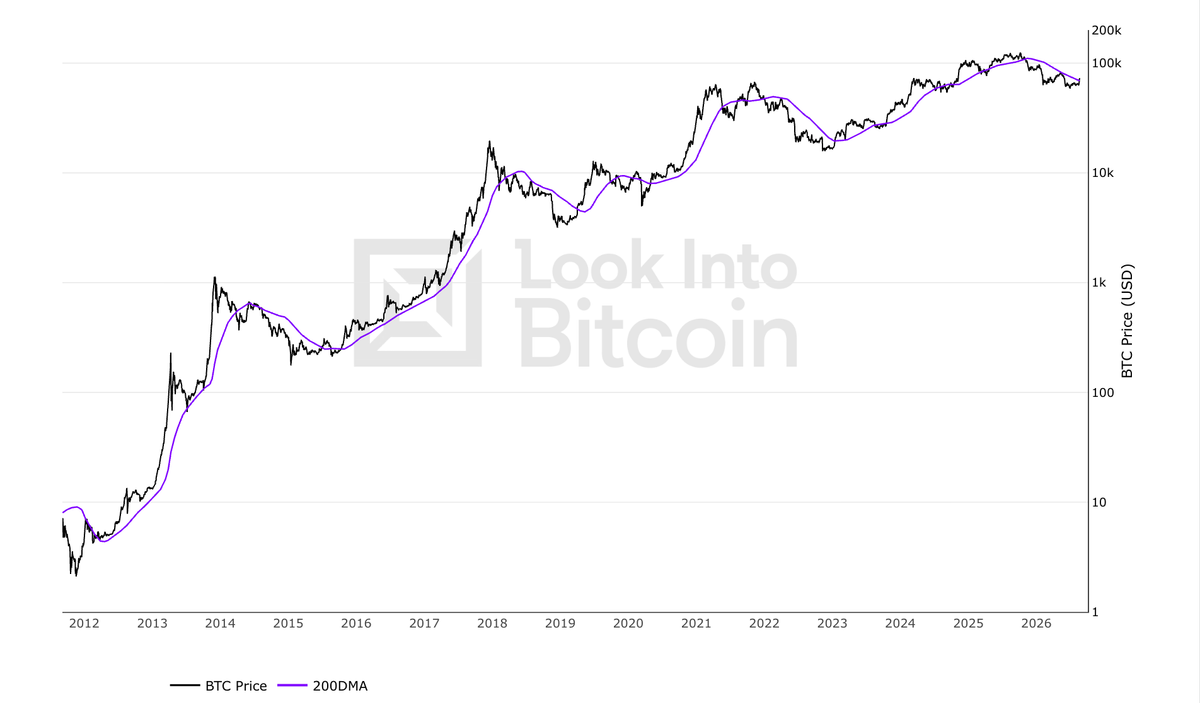
That's why this specific break matters so much to the optimists. As analyst Caleb Franzen frames it, bull markets are defined by price holding above key long-term averages, and reclaiming that line after months below it is exactly the kind of shift that can mark a trend change. Some bulls go further: one trading desk argued in a widely shared note that every single time Bitcoin has reclaimed its 200-day average after a drawdown of this size, it has marked the end of the cycle, adding that BTC and ETH's roughly 54% and 70% peak-to-trough falls have historically been the kind of capitulation that precedes recoveries.
The catalysts: liquidity and Washington
Two concrete events lit the fuse, and neither was crypto-native.
First, the US Treasury moved to at least double the size of its liquidity-support buybacks for longer-dated bonds, raising the cap from $2 billion to at least $4 billion per operation. It's not quantitative easing, but it injects liquidity into the financial system, and Bitcoin has always been, at heart, a liquidity story. Second, the SEC and CFTC pushed ahead of Congress with unusually crypto-friendly rules, including the SEC's new "Regulation Crypto" fundraising framework, signaling Washington will keep clearing the runway for digital assets.
Bullish analysts argue these two stories were "the match that lit the rally", the fundamental spark that turned a dead-quiet market. There's an old trading adage they're fond of right now: never short a dull market, especially at the bottom of a cycle.
The catch: this was a short squeeze
Here's what the euphoria glosses over. A large share of this week's move wasn't fresh buyers, it was forced buying. When Bitcoin broke key resistance and its 200-day average, it triggered a cascade of liquidations among traders who'd bet against it, forcing them to buy back in and driving the price higher in a self-reinforcing loop. Total liquidations ran into the billions across the rally.
One researcher put it bluntly: more than half of Wednesday's 7.1% gain happened inside a single hour, on about a third of the day's volume, which is "the signature of a short squeeze," not organic demand. Another pointed contrast came from gold, which rallied cleanly on the same Treasury news without any forced buying, leading some to argue bullion, not Bitcoin, carried the week's real macro signal. Short squeezes are real and can kick off sustained trends, but they can also exhaust themselves once the trapped shorts are flushed out.
The battleground: $78,000
Bitcoin's surge has carried it right up to the level that matters most. The $78,000 zone is a structural ceiling, the price BTC has repeatedly failed to breach earlier this year, and it's now the line between "violent bounce" and "confirmed breakout." Analysts are watching the weekly candle close obsessively: a decisive weekly close above $78,000 would flip that ceiling into a floor and, by several technical reads, open a rapid path toward the psychological $90,000 barrier. A rejection here, and a close back below, could send Bitcoin retesting $70,000. In other words, the next few daily closes may set the tone for the rest of the quarter.
So is the bottom in? The pros are split
This is where honesty demands nuance. Analysts are genuinely divided.
The bull case: the 200-day reclaim, the capitulation-sized drawdown that's now reversing, roughly 315 days into a bear cycle that historically runs about this long, miner capitulation largely complete, and supportive policy plus liquidity. Some desks are confident enough that they've closed their entire short books. Price targets among the most bullish run from $90,000 in the near term to $175,000 over the full cycle via Fibonacci projections.
The bear/caution case: the rally is squeeze-driven, not inflow-driven; Bitcoin's 14-day RSI is flashing "overbought" near 80, a zone that historically precedes cooling-off; the 200-day average is still declining and may need to be retested from above; and without sustained spot ETF inflows and easier macro conditions, several analysts warn Bitcoin could stall in the $75,000-$78,000 zone, exactly where it sits now. One firm noted Bitcoin recently flashed the majority of its historical "capitulation" signals, setups that have sometimes preceded below-average returns.
What it means
A few grounded takeaways. Reclaiming the 200-day moving average and charging to $78K is a real, meaningful bullish development, not hype, and it shifts the burden of proof toward the bulls for the first time in months. But a rally powered substantially by a short squeeze needs follow-through, specifically, real spot and ETF buying, to confirm it's more than a violent bounce, and the $78,000 weekly close is the single cleanest test of that. Above it, $90,000 comes into view; rejection sends BTC back toward $70,000.
One structural note worth flagging from the more thoughtful bulls: even in an optimistic scenario, they argue this cycle will reward protocols with real revenue and value-returning tokenomics, while most "crypto-native" tokens from past cycles stay dead. In other words, "a bull run is back" would not mean "everything pumps like 2021." The market has become far more discerning about what actually has value, a healthy maturation, even if it's less fun for lottery-ticket buyers.
What to watch: whether Bitcoin can post a weekly close above $78,000, whether spot Bitcoin ETF inflows turn sustainably positive, the $90K target versus a $70K retest, and whether momentum survives once this week's short liquidations are fully worked through.