One of the world's largest crypto exchanges just pulled a powerful group of financial heavyweights onto its cap table. OKX announced a strategic investment from stablecoin issuer Circle, payments firm Ripple, Standard Chartered's venture arm, and a major quantitative trading firm, at a $25 billion valuation. The investors involved, and what OKX says it plans to do with the money, say a lot about where the industry is heading: the walls between crypto and traditional finance are coming down fast.
The deal
OKX completed a strategic investment at a $25 billion pre-money valuation, with four new backers: Circle (issuer of the USDC stablecoin), Ripple (payments and the RLUSD stablecoin), SC Ventures (the venture arm of Standard Chartered), and Qube Research & Technologies (QRT), a London-based quantitative investment manager. OKX did not disclose the dollar amount raised.
Notably, the valuation held flat at $25 billion, the same as OKX's March round, which was led by Intercontinental Exchange (ICE), the parent company of the New York Stock Exchange, with roughly $200 million invested. CEO Star Xu framed it as a position of strength rather than need, posting that OKX "didn't raise capital because we needed it," but rather to deepen ties with key infrastructure partners.
The real story: the investor lineup
The amount matters less than who is writing the checks, because this group reveals OKX's strategy. Each investor represents a different piece of the emerging on-chain financial stack:
- Circle brings the dominant regulated stablecoin (USDC), already integrated across OKX.
- Ripple brings payments infrastructure and its RLUSD stablecoin, now available across OKX's order book.
- Standard Chartered is a major global bank that already serves as custodian for BlackRock's BUIDL tokenized Treasury fund under a collateral arrangement involving OKX and BlackRock, deep institutional plumbing.
- QRT is a sophisticated quant trading firm that benefits from deeper, more liquid institutional markets.
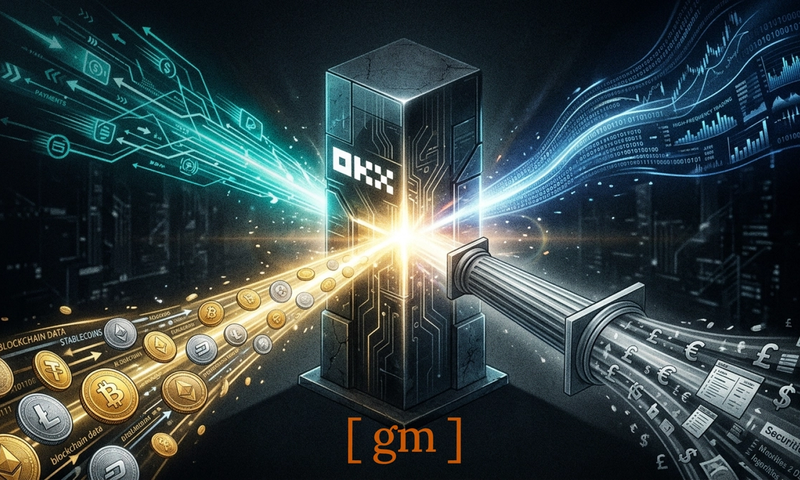
Put together, that's a stablecoin issuer, a payments/stablecoin firm, a global bank, and an institutional trading powerhouse all investing in the same exchange. As OKX's Star Xu put it, "the exchange was our starting point, and we are evolving into a broader global financial technology platform." The goal: let customers hold, spend, invest, and grow their money all in one place, a crypto exchange becoming a full-stack fintech.
Why it matters
This deal is a vivid snapshot of crypto's convergence with traditional finance. A year ago, a crypto exchange raising from a crypto-native crowd was the norm. Now OKX is raising from a global systemically-important bank (Standard Chartered), the NYSE's parent (ICE, in March), two of the biggest stablecoin issuers, and a top quant fund, the kind of names that signal crypto infrastructure has become something mainstream finance wants to own a piece of, not just watch.
It also reflects the broader shift playing out across the industry in recent weeks: Goldman Sachs routing a $100B Treasury fund onto blockchain rails, Nasdaq investing in Kraken's parent, and OKX's own joint venture with ICE to build a 24/7 tokenized-stock market. The common thread is tokenization and stablecoins becoming core financial infrastructure, and the biggest crypto platforms positioning to be the rails that everything runs on. For OKX, the flat $25 billion valuation might look unremarkable on the surface, but the composition of its backers is the headline: the exchange is assembling exactly the partners it needs to blur the line between crypto trading, payments, and traditional finance. Whether it can execute on that "global fintech platform" ambition is the open question, but it now has the backers to try.