Trading memecoins on the popular app FOMO has been a losing bet for the overwhelming majority of its users, according to a new onchain analysis that paints a brutal picture of the Solana memecoin economy.
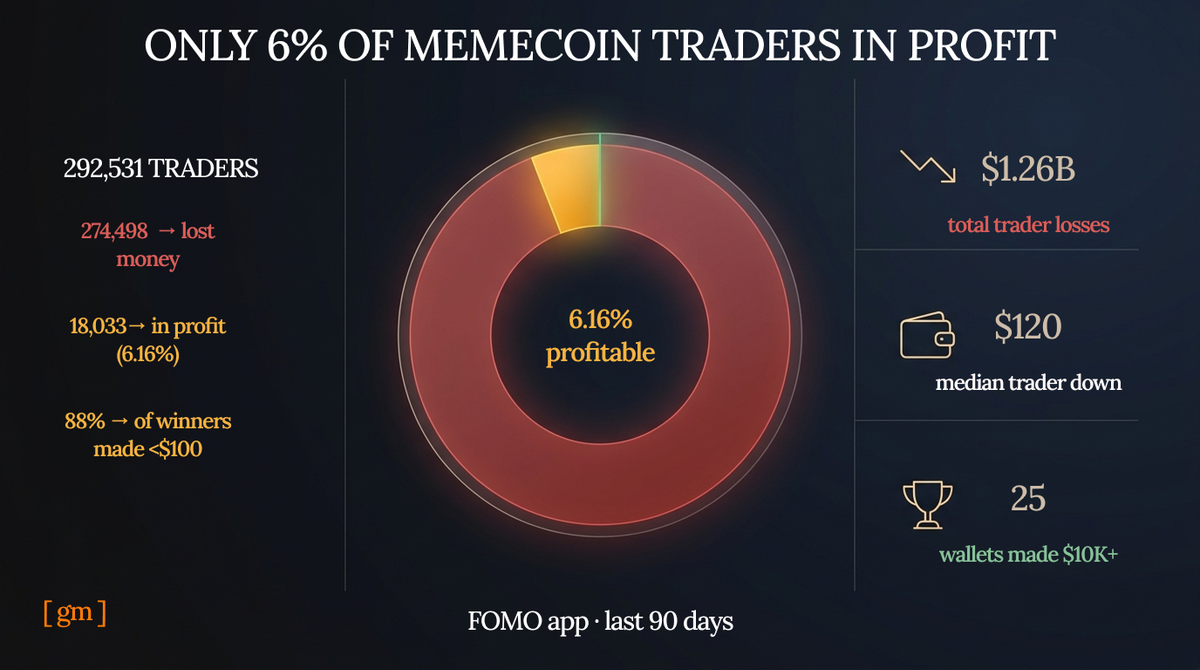
Analyst MidCurveMortal (on X) built a public Dune Analytics query tracking the profitability of every active FOMO trader over the past 90 days, using the app's fee router to calculate results. The findings, which should be read as one analyst's calculation: of the 292,531 wallets that traded through FOMO in the last three months, only 18,033 were in profit, roughly 6.16% of all traders.
The rest of the numbers are worse the closer you look. As a group, FOMO traders are down an estimated $1.26 billion over the period, with the median trader losing around $120. Even among the small minority in the green, the gains are mostly trivial: according to the analysis, 88% of profitable traders made under $100, and just 25 wallets, out of nearly 300,000, made more than $10,000.
The comparison that stings. To put the 6% figure in context, MCM contrasted it with online gambling. A wagering platform such as Rainbet, operating with a roughly 1% house edge, reportedly sees around 37% of its users in profit over a comparable period. In other words, by this analysis, a trader would have been about six times more likely to come out ahead betting on a gambling site than trading memecoins on FOMO. The query is public, letting anyone check the methodology.
Why this rings true. While these specific figures come from a single independent analyst and haven't been officially confirmed, they align almost exactly with everything previously documented about memecoin trading. Repeated Dune Analytics studies of Solana's largest memecoin launchpad – Pump.fun, found that the majority of traders lose money and only a tiny fraction ever clear meaningful profit, with roughly 90% of participants either losing money or making under $100, nearly identical to the FOMO distribution. Analysts have long described memecoin markets as effectively "player-versus-player": zero-sum, or negative-sum after fees, where late and inexperienced arrivals tend to fund the winners.
What FOMO is. For context, FOMO is a social-trading app focused on memecoins, primarily on Solana, that has processed over $1.5 billion in volume and generated more than $5 million in fees, according to third-party reviews, with tens of thousands of users. The app itself earns from trading activity regardless of whether its users win or lose, the same structural reality that makes memecoin platforms profitable even as most of their traders are not.
Why it matters. The name says the quiet part out loud. Memecoin trading is fueled by fear of missing out, and the occasional life-changing win gets amplified across social media while the far larger population of losers stays silent. Data like this is a rare look at the full distribution, and it consistently tells the same story: a handful of winners, an ocean of losers, and a platform collecting fees off the churn. It's a reminder that behind viral "made it" screenshots, the base rate for memecoin trading looks less like investing and more like a casino, and by this analysis, a casino with worse odds than an actual casino.