In an institutional milestone for the digital asset landscape, the U.S. Securities and Exchange Commission (SEC) has officially approved a proposal by Nasdaq to list and trade cash-settled Bitcoin index options. According to the regulatory filing published on Friday, the new financial instruments will trade on the Philadelphia Stock Exchange (Phlx) under the ticker symbol QBTC.
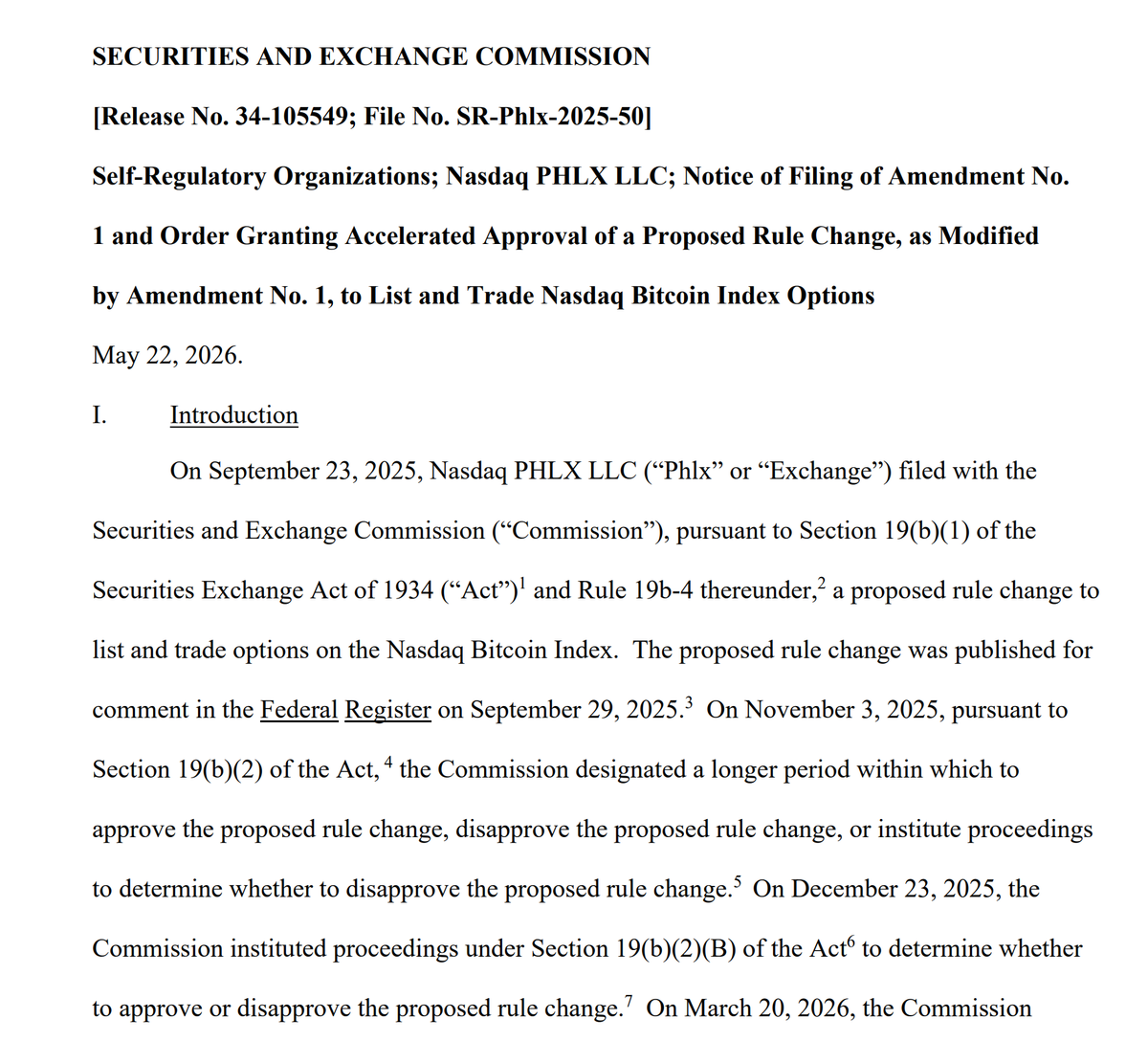
Source: SEC
Unlike standard options tied directly to spot Bitcoin exchange-traded funds (ETFs), these cash-settled, European-style contracts track the broader market performance without requiring the physical delivery of the underlying asset. Specifically, the options are tied directly to the Nasdaq Bitcoin Index. This benchmark is engineered to mirror exactly one one-hundredth of the CME CF Bitcoin Real Time Index, a highly sensitive tracker that aggregates price feeds across major cryptocurrency platforms and updates every 200 milliseconds.
Because these options utilize a European-style execution model, they can only be exercised upon expiration. For large institution-grade market participants, this eliminates the danger of early assignment, providing a cleaner framework for hedging portfolios and deploying sophisticated volatility strategies.
Per the SEC’s official order, the QBTC contracts will feature a minimum price increment of $0.01. Position limits have been established at 24,000 contracts on either side of the market—a cap that represents roughly 0.12% of the total outstanding Bitcoin supply, ensuring ample market liquidity while curbing structural manipulation.
The Final Hurdle: Resolving the Gridlock with the CFTC
While the SEC's accelerated approval is a massive regulatory victory, institutional traders will have to wait to buy or sell QBTC contracts. Because Bitcoin is legally classified as a commodity under U.S. law, the launch is strictly contingent on the Commodity Futures Trading Commission (CFTC) providing its own exemptive relief.
This jurisdictional division has previously ignited industry pushback. Notably, the CME Group—which has monopolized regulated Bitcoin futures and options trading since 2020—filed a comment letter strongly arguing that index-tied digital asset contracts fall under the exclusive jurisdiction of the CFTC.
However, the SEC countered this defense by pointing to Section 717 of the Dodd-Frank Wall Street Reform and Consumer Protection Act. The agency asserted that joint oversight is a common market practice, emphasizing that concurrent jurisdiction naturally activates once the CFTC approves the exemption.
“The concept of shared jurisdiction between the Commission and the CFTC is not new,” the SEC stated in its order, referencing historically blended products like mixed swaps and security futures.
A New Strategic Direction at the SEC
The fast-tracked approval highlights a profound shift in Washington's digital asset oversight. Under the leadership of Chairman Paul Atkins, the agency has rapidly abandoned the aggressive "regulation by enforcement" strategy that dominated previous years.
Atkins has spearheaded efforts to drop several legacy lawsuits against major crypto entities, advocating instead for clear, predictable, and supportive guardrails aimed at keeping financial innovation within the United States. Beyond traditional options, the SEC is reportedly drafting an ambitious "innovation exemption." If passed, this rule would allow decentralized blockchain networks to facilitate the tokenized trading of public equities—potentially reshaping the future of global capital markets.
Related Links for Further Reading:
- To read the official regulatory filing, visit the Securities and Exchange Commission (SEC).
- For structural tracking details on digital asset indexes, check out the Nasdaq Indexes Portal.
- To track institutional volume and derivative trends, visit the CME Group Cryptocurrency Products.