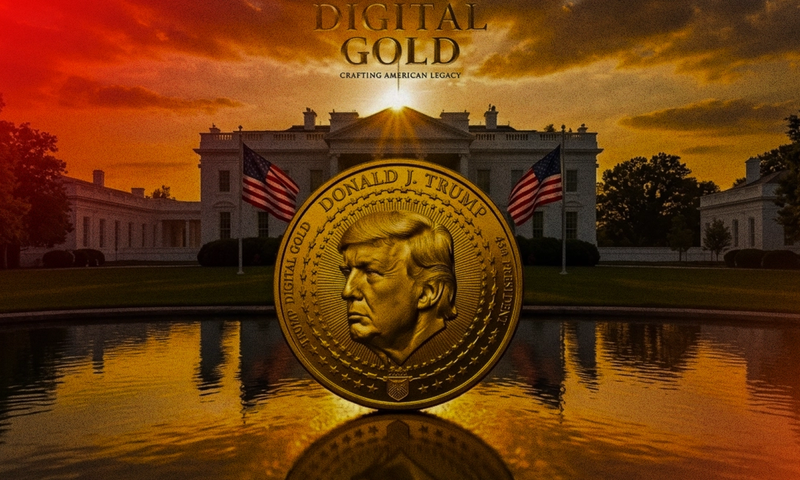
A cryptocurrency called $GOLD, marketed as "Trump Digital Gold," soared to a roughly $60 million market cap and then collapsed in an apparent rug pull within hours of launch, after being promoted from a verified X account that is followed by President Donald Trump's official account. On-chain analysts flagged the token as a likely scam before it crashed, but many buyers, believing it was an official Trump project, bought in and were left holding tokens worth a fraction of what they paid. It's the latest and one of the more convincing entries in a long run of Trump-branded crypto scams.
What happened
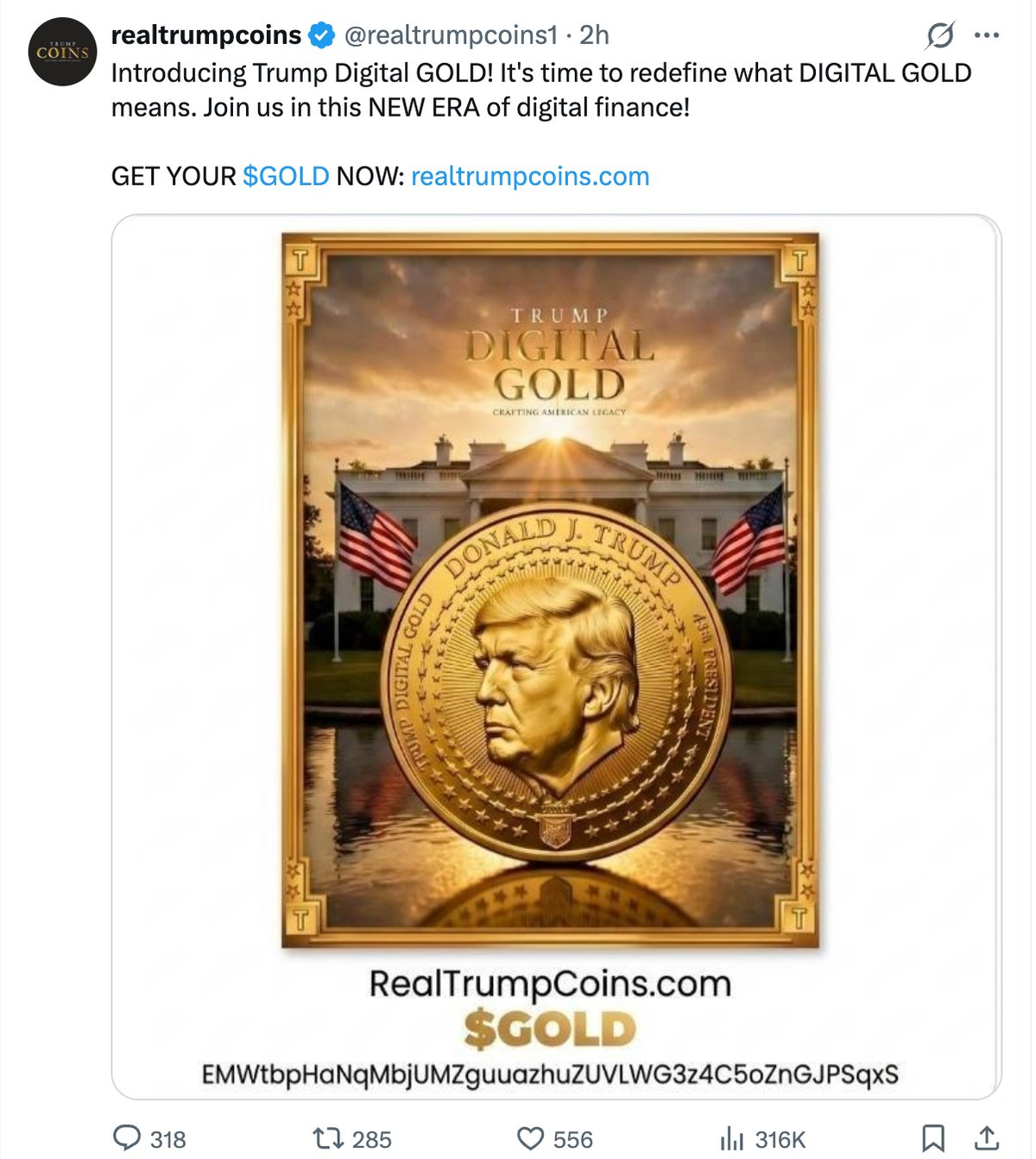
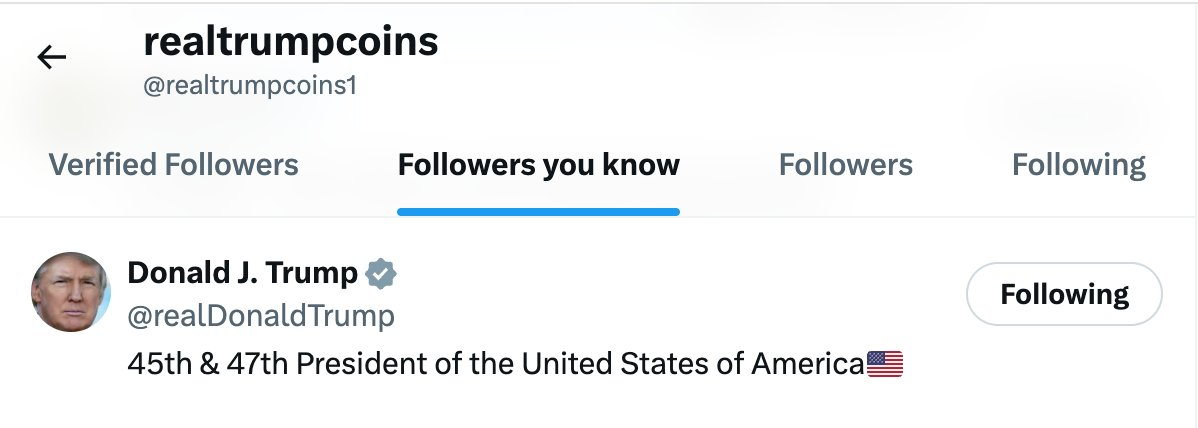
The account @realtrumpcoins1, displaying a verified checkmark and, notably, followed by the official @realDonaldTrump account, promoted a new token: "Introducing Trump Digital GOLD! It's time to redefine what DIGITAL GOLD means," directing followers to a website and the $GOLD contract address. The apparent legitimacy signals, a verified badge, the Trump follow, polished branding featuring a golden Trump coin and the White House, led many to believe it was a genuine new Trump crypto launch.
According to a widely circulated analysis by on-chain tracker Lookonchain, the setup had every hallmark of a scam from the start. The developer held 600 million $GOLD, and 15 newly created wallets spent roughly $18,657 to buy an additional 224.5 million tokens, leaving the team in control of about 82.45% of the total supply. Lookonchain posted a blunt warning: "Be cautious!"
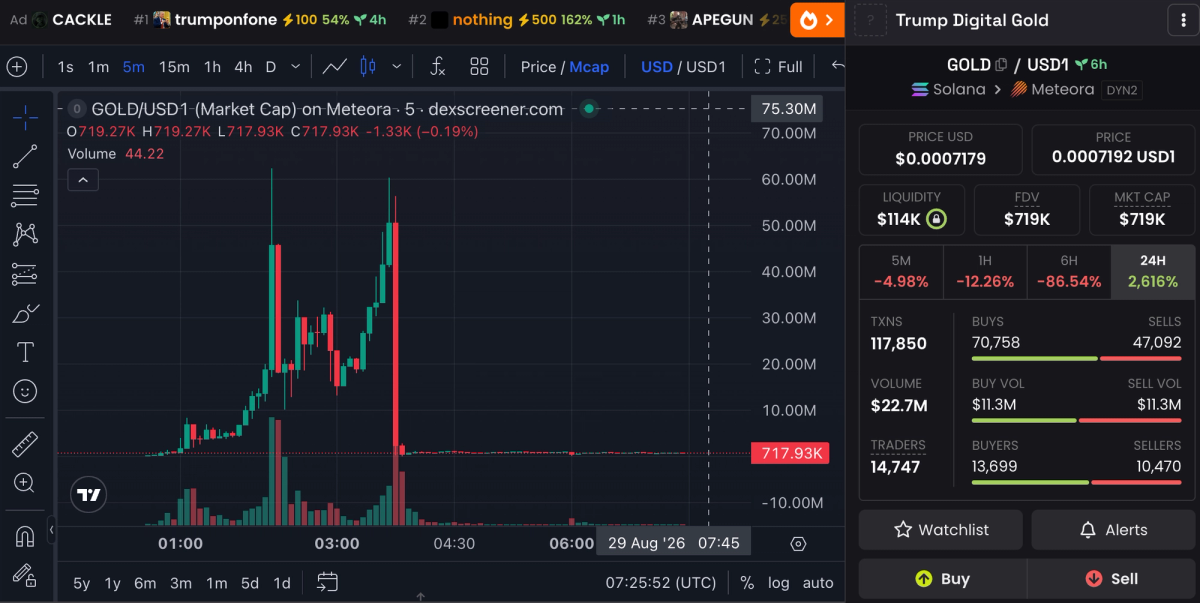
That caution proved warranted within hours. The token exploded to a peak market capitalization of roughly $60 million, drawing over $22 million in trading volume across more than 117,000 transactions and nearly 15,000 traders, before the team pulled the plug. Its market cap then cratered roughly 87%, wiping out the vast majority of that value and leaving it near $757,000. Lookonchain confirmed the outcome: the 15 team-linked wallets sold all 224.5 million $GOLD for 3,178 SOL, about $330,000, a roughly $312,000 profit and a 17x return on their initial buy-in. Shortly after, the realtrumpcoins account deleted its posts about $GOLD.
It's worth understanding the gap between those two figures, because it's the part most people get wrong. The ~$60 million "market cap" was a paper valuation resting on thin liquidity, the theoretical worth of all tokens at the peak price, not real money sitting in a vault. The ~$330,000 the team actually pulled out reflects the genuine capital that was in the trading pool. In rug pulls, the headline market cap almost always dwarfs both what the scammers can actually cash out and what victims collectively lose, but for the people who bought near the top, the personal losses were very real.
The "hacked account" question
Here's the critical, and still-unconfirmed, wrinkle. According to community reports circulating alongside the on-chain analysis, the realtrumpcoins account and its associated domain may have been compromised, hijacked and used to launch $GOLD, rather than the account's normal operators running the scam themselves. If true, it would fit a growing pattern of attackers taking over crypto-adjacent accounts to lend fake legitimacy to a token before draining it.
This detail matters and should be treated as an open question. "My account was hacked" is also one of the most common defenses offered after a rug pull, and it's frequently met with skepticism, as happened in other recent influencer rug-pull cases. At the time of writing, the compromise claim has not been independently verified, and it's unclear who controlled the account when $GOLD launched. What is verifiable on-chain is the token's supply concentration and the team wallets' coordinated sell-off.
Why people fell for it
This scam worked because it stacked believable signals. A verified checkmark, a follow from the actual @realDonaldTrump account, a professional-looking campaign, and a plausible "digital gold" narrative all combined to lower people's guard. And there was real precedent to make it credible: President Trump genuinely launched an official $TRUMP memecoin in January 2025, followed by an official $MELANIA token, so a "new Trump coin" no longer sounds absurd on its face. That blurring of the line between real and fake Trump crypto ventures is exactly what scammers exploit.
Notably, the official $TRUMP token was reportedly trading higher and unaffected during the $GOLD episode, underscoring that $GOLD was a separate, unofficial project, whatever the status of the account that launched it.
The bigger pattern
$GOLD joins a crowded field of Trump-family-themed crypto scams. Since the official $TRUMP launch, fraudsters have repeatedly exploited the family name: a fake Eric Trump token rug-pulled from a $160 million market cap to near zero in May 2025, and fake Barron-themed coins circulated before that. The formula is consistent, borrow the credibility of a famous name, manufacture legitimacy signals, pump the token, and dump on believers.
The episode also renews long-running criticism of the entire concept of a sitting president having namesake tokens at all. Even the official $TRUMP coin drew accusations of being a wealth-transfer scheme, with most small buyers losing money while insiders profited, and lawmakers have demanded SEC investigations. When the president's own brand is a crypto asset, it becomes nearly impossible for ordinary users to tell official ventures from scams, and scammers thrive in exactly that confusion.
How to protect yourself
The $GOLD rug is a textbook case study in the red flags every crypto user should internalize:
- A verified badge and a follow mean nothing. Accounts get hacked, badges get bought, and follows get faked or misread. Never treat social signals as proof a token is legitimate.
- Check the supply concentration. Tools like the ones Lookonchain and Bubblemaps use reveal when a tiny number of wallets, or the dev, hold the vast majority of a token. 82.45% team control, as here, is a screaming red flag.
- Beware freshly created wallets buying in. A cluster of brand-new wallets buying a new token, as flagged here, is a classic bundling tactic to fake organic demand.
- Official launches are announced through many verified channels at once. A single account, one website, and urgency ("GET YOURS NOW") is how scams operate, not how legitimate multi-million-dollar projects launch.
- If you have to rush, it's probably a trap. Rug pulls depend on FOMO. Real opportunities survive due diligence.
Beyond the roughly $330,000 the $GOLD operators walked away with, the real damage is to trust and to the everyday people who believed they were buying into something official and bought near a $60 million valuation that evaporated in minutes. As long as the line between genuine and fraudulent celebrity, and presidential, crypto ventures stays blurred, these scams will keep working.
What to watch: whether realtrumpcoins confirms a hack or is exposed as the operator, whether on-chain sleuths trace the ~3,178 SOL, any response from Trump's official crypto team distancing from $GOLD, and whether platforms flag or freeze related wallets.
This is a developing story based on onchain analysis; some details, including the alleged account compromise, are unverified at publication and will be updated. This is educational information, not financial advice. Never buy a token based on social-media hype alone.