Variational is having a moment. The derivatives platform has climbed into the top ranks of perp DEXs, drawn a wave of point-farmers chasing a potential airdrop before its rewards program ends this month, and it's backed by heavyweight funds including Coinbase Ventures and Dragonfly. But nearly every writeup explains it wrong, and the misunderstanding matters, because it hides both why Variational is genuinely interesting and where the real risks lie.
What Variational actually is (and isn't)
Most coverage says Variational is "an RFQ perp DEX instead of an order book." Co-founder Lucas Schuermann says that framing misses the point, the request-for-quote mechanism is just plumbing. The real distinction is deeper: Variational isn't an exchange, it's a dealer.
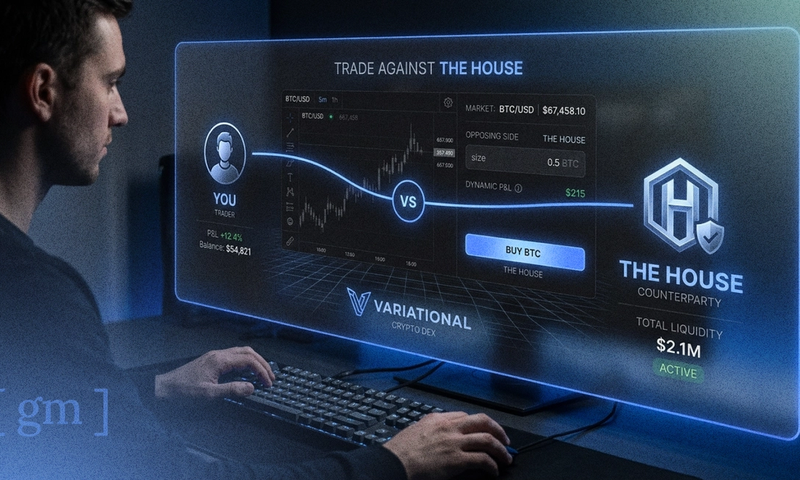
An exchange like Hyperliquid is a neutral venue that matches buyers and sellers and takes a fee, never holding a position itself. Variational's retail app, Omni, works completely differently. Every trade you make is taken by the Omni Liquidity Provider (OLP), a single, in-house market-making desk run by the team using the protocol's own capital. It absorbs your position, keeps part of the risk on its books, and hedges the rest on outside venues. As one summary of Schuermann's own explanation put it: Variational "runs a prop shop on the other side" of your trade. You're not trading against the market. You're trading against the house.
That's the founders' pedigree showing through. Schuermann and co-founder Edward Yu met at Columbia, ran a quant fund that folded into crypto giant Genesis Trading (where they handled enormous derivatives volume), then ran their own proprietary trading firm before building Variational. In May 2026 they raised a $50 million Series A led by Dragonfly, with Bain Capital Crypto and Coinbase Ventures participating, roughly $61.8M raised in total.
How it takes zero fees and still makes money
Here's the elegant part. Omni charges no maker or taker fees, at any size. So how does it earn? All of its revenue sits in the bid-ask spread of the quote OLP gives you. The protocol keeps about 20% of that spread; the rest stays with OLP to cover risk and hedging. A normal exchange pays outside market makers for liquidity and charges the trader a fee, bleeding value from both ends. Here, the market maker is the platform, so there's no leakage.
The genuinely clever mechanism underneath is flow segmentation. A market maker quoting into an anonymous order book doesn't know if you're a regular trader or a high-frequency shop about to pick them off, so they widen spreads to protect against that risk, and everyone pays for it. OLP, by contrast, sees exactly who you are, your account, size, and history. Retail flow gets tagged as "non-toxic" and quoted much tighter. As Schuermann bluntly notes, retail is cheap here not because there's no fee, but because you've been identified. There's also a scale flywheel: the more flow OLP handles, the more trades cancel out internally without needing external hedging, so, unusually, the protocol's margin and the user's spread can improve at the same time. (The trade-off: there's no public API yet, all flow goes manually through the interface, by design.)
The RWA bet and the swaps twist
Variational's fastest-growing edge is real-world-asset perps, contracts on gold, silver, copper, and oil, where Schuermann says it holds 12-13% of on-chain open interest versus 1-2% for most rivals. But perps on real assets are notoriously messy: a contract on oil doesn't track a clean spot price, funding rates can spike wildly (early versions of such contracts saw weekend funding rates hit thousands of percent annualized), and every venue defines its index differently.
Variational's answer is to question the instrument itself. It launched swaps, closer to a "total return swap" institutions use, with a price leg that tracks the asset and a financing leg pegged to SOFR (the base US dollar rate) at roughly SOFR + 100 basis points, a far more predictable ~4.5-5% cost of carry versus the 7-10% perp funding often settles at. Variational is currently doubling points on swap volume to drive adoption.
The risks the hype leaves out
This is where the "dealer, not exchange" distinction becomes essential, because it reshapes the risk profile, and the farming crowd rarely mentions it.
You trade against the house. With a single internal counterparty rather than a transparent order book, you're trusting OLP's pricing and risk management. Lighter, another zero-fee venue, uses a real order book with cryptographically provable execution; Variational changed the construction itself. That's the source of both its advantages and its risks.
The "predictable" financing rate is a commercial arrangement, not a property of the instrument. Interviewer Corey Hoffstein pressed on this: he was quoted a similar swap at SOFR+100 in January and SOFR+300 recently, purely because bank balance-sheet availability tightened. Schuermann said Variational's scale lets it hold rates steady, but acknowledged the dealer agreements contain safeguards for when markets shift. The honest read: the smooth carry holds until the day it becomes inconvenient for whoever sets it. A perp at least shows stress in real time.
Hedging depends on external market depth. Hoffstein raised a sharp point: if Variational pulls all the soft retail flow off public order books, those books get thinner and more toxic, making Variational's own hedging more expensive. Schuermann framed scarce non-toxic flow as a negotiating advantage, but agreed the number of hedging venues would shrink.
And the standard farming caveats apply, hard. The VAR token isn't live; the only described use case in the docs is buy-and-burn, phrased as "may" with a right to cancel. Omni is invite-only and closed to US and Canadian users. Earning points requires trading real USDC with leverage on Arbitrum, meaning real capital at risk, and points programs routinely change terms, adjust distributions, and run retroactive anti-Sybil clawbacks. The airdrop everyone's farming toward is expected but not guaranteed, in size, value, or existence.
Variational is one of the more genuinely novel designs in a sector full of Hyperliquid clones, an attempt to bring the trillion-dollar OTC derivatives world on-chain by making the platform the dealer rather than the venue. For traders, that can mean tighter spreads, zero fees, and access to RWA and swap products that barely exist elsewhere. But it also means trusting a single counterparty and a financing model that's smooth by commercial agreement rather than by market mechanics. The farming frenzy is real and the deadline (rewards reportedly ending by the close of Q3, i.e. September 30) is driving urgency, but the smartest way to approach Variational is to understand what it actually is first. It's not a fee-free exchange with a free airdrop attached. It's a dealer, and you're the counterparty.
This is educational information, not financial advice. Perpetuals and leverage carry a high risk of total loss; airdrops are speculative and never guaranteed. Omni is unavailable to US and Canadian persons. Always do your own research.