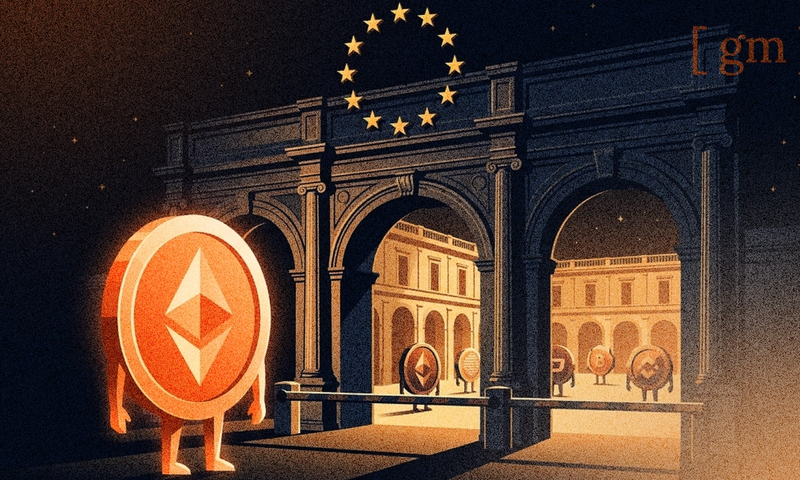
On July 1, 2026, Binance — the biggest cryptocurrency exchange on the planet by trading volume — stopped offering new services to users across the European Union. Not because of a hack, a ban, or a court order, but because it couldn't get a license that hundreds of smaller competitors already held. To understand why, you have to understand MiCA, and one phrase buried inside it: "fit and proper."
This is an explainer, not a breaking story — the goal is to make a genuinely confusing regulatory event make sense, whether you're reading it the week it happened or a year later.
What is MiCA, in one paragraph
MiCA — the Markets in Crypto-Assets Regulation — is the European Union's single rulebook for crypto, fully in force since 2024 after a transitional period. Before it, a crypto company had to deal with 27 different national regimes. MiCA replaced that patchwork with one system: get authorized as a Crypto-Asset Service Provider (CASP) in any one member state, and you can "passport" that license across the entire bloc. One approval, 27 countries. It's the same design logic the EU used for banking and traditional finance — and it's exactly the framework the United States is still fighting to create with the CLARITY Act.
What actually happened to Binance
The transitional window that let existing crypto firms keep operating while their applications were processed had a hard end date: July 1, 2026. Miss it without an approved license, and you must stop serving EU users — full stop. Europe's securities regulator, ESMA, had told unauthorized providers plainly to wind down their EU activities. There was no extension and no partial-compliance carve-out.
Binance bet on Greece as its entry point, filing its application there in January 2026. But on June 24 — six days before the deadline — it withdrew that application, reportedly one week after news that the Greek regulator was preparing to reject it. With no license and no time left, Binance notified users in France, Italy, Spain, Poland and other member states that from July 1, new spot orders, deposits, sign-ups and staking products would stop. In France alone, that reportedly affected around 2 million users.
One crucial distinction most headlines blurred: this is a suspension, not a seizure or a shutdown. User funds remained safe and withdrawable throughout. Binance framed it as a strategic retreat rather than a defeat, said it is not leaving Europe, and stated it would seek a license through another member state — reportedly France — and expects to return. Whether it does is the open question.
The "fit and proper" test — the part that actually sank Binance
Here's the concept at the center of the whole story. MiCA doesn't just examine a company's paperwork, capital and security systems. It also examines the people who own and run it. Under the "fit and proper" test, regulators assess whether an applicant's owners and senior managers have the integrity, reputation and clean track record to be trusted with a licensed financial business.
Reporting on the Greek rejection suggested it turned not on Binance's technology or documentation but on its past — its history of regulatory penalties, and specifically whether co-founder Changpeng Zhao ("CZ") could pass the fit-and-proper standard for owners. Binance's earlier settlement with the US Department of Justice and Zhao's personal legal history cast a long shadow. In plain terms: the problem wasn't what Binance filed. It was who Binance is.
This is the single most important lesson of the episode. In MiCA's Europe, a spotless application can still fail if the regulator decides the ownership doesn't meet the integrity bar. For an industry whose biggest names carry complicated histories, that's a profound shift.
Why this matters even if you never used Binance
MiCA has teeth. Of more than 3,000 crypto firms operating in Europe, only around 210 secured authorization. Rivals including Coinbase, Kraken and OKX passed; the largest exchange in the world did not. That gap is the clearest possible signal that European licensing is a real filter, not a rubber stamp — and every exchange still waiting on an application is now studying the Binance case closely.
Compliant competitors win the spoils. Licensed exchanges immediately moved to court displaced Binance users with cashback and bonus offers. In regulated markets, a competitor's compliance failure is a customer-acquisition event.
The transatlantic split is widening. Europe now has a working, enforced licensing regime that can shut out even the biggest player. The US, by contrast, is still debating its market-structure rules. One region enforces; the other deliberates. For firms deciding where to build, that contrast is becoming decisive.
What this means for Central & Eastern Europe
For users and builders across CEE — including markets like Ukraine with large, active crypto communities — the Binance lockout is a preview of the rules that increasingly govern the whole region's access to crypto. As countries align with or formally adopt MiCA-style frameworks, the same logic applies: the exchange you use needs a CASP license to serve you legally, and the "fit and proper" bar means brand size is no guarantee of survival. Choosing a licensed platform is no longer just prudent — it's the difference between uninterrupted access and a withdrawal-only account.
The bottom line
Binance wasn't locked out of Europe on a technicality. It was locked out because MiCA judges the owner as much as the application — and on that test, the world's largest exchange couldn't clear the bar in time. Whether Europe becomes a comeback story or a prolonged exclusion now depends on whether Binance can satisfy a regulator that its house is genuinely in order.