The day the crypto industry has been fixated on for months is finally here, and the biggest surprise is how uncertain it still is. The US Senate's cloture vote on the CLARITY Act is scheduled for 2:15 p.m. ET today, the procedural test that decides whether America's landmark crypto legislation advances or stalls for years. Yet as of this morning, nobody knows for sure how it will go, or whether it will even happen at all.
A "Schrödinger's cat" of a vote
CoinDesk aptly described the bill's status as a Schrödinger's cat in "life-death limbo", neither entirely alive nor dead. Depending on who you ask, the CLARITY Act has a real shot at a last-second deal that catapults it toward law, no shot at all, a future as a provision folded into some other bill, or years in legislative purgatory. The honest read across Washington is closer to a shrug than a prediction.
There's also a live possibility the vote simply doesn't occur today. Some crypto insiders have suggested it could be postponed, and that can be read two ways. Optimists say a delay would mean last-minute bipartisan talks are still constructively moving and both sides want to lock in the votes before going on the record. Pessimists say it would mean the votes simply aren't there, with some Republicans still worried about stablecoin yield programs that compete with banks' interest-bearing deposits. Either way, today may not deliver the clean, dramatic verdict the market is bracing for.
Why the odds have collapsed
The mood has darkened sharply since the spring. Prediction markets tell the story: Polymarket odds of the bill becoming law in 2026 have collapsed from 82% in February to around 16% by early September, and Galaxy Research pegs the probability even lower, near 10%.
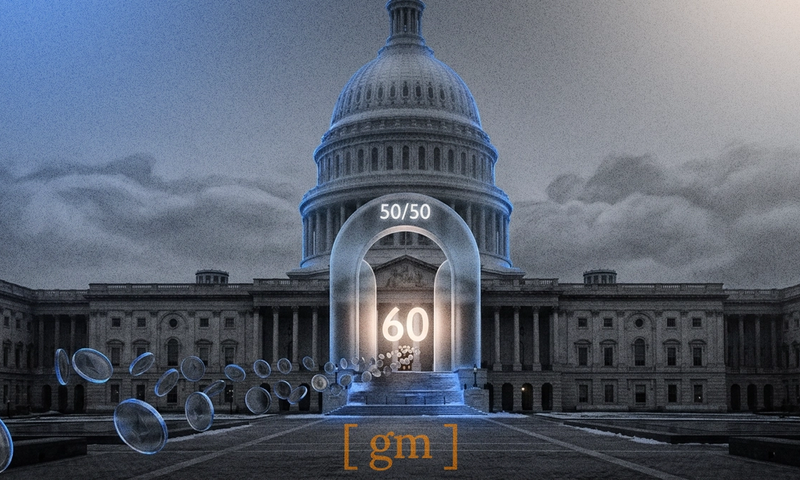
The math explains the pessimism. Cloture requires 60 votes. Republicans hold 53 seats, so even with full party unity they need at least seven Democrats to cross over, and unity isn't guaranteed. Three unresolved disputes are blocking a deal: ethics rules targeting President Trump's crypto business interests, DeFi developer liability, and a stablecoin-yield provision. Several Democrats have explicitly tied their support to stronger ethics provisions, and a bipartisan ethics counterproposal from late July reportedly still hasn't gotten a White House response. Meanwhile, Senator Elizabeth Warren is leading vocal opposition, having branded the bill industry-written and "dead on arrival."
The shrinking calendar makes it worse
Timing is working against the bill. House Republicans recently shortened the September legislative calendar by roughly eight voting days, canceling planned working weeks and pulling Congress's finish line forward by about two weeks ahead of the November midterms. That leaves precious little floor time for the extended debate, amendments, and final votes the bill would need even if today's cloture succeeds. If senators amend the text in late September, it could arrive to a nearly empty chamber.
What today actually decides (and doesn't)
Keep the stakes precise. Today is not a final vote on whether CLARITY becomes law, it's a procedural vote on whether the Senate can even begin formal debate. Clear the 60-vote bar, and the bill advances to the floor for debate and amendments. Fall short, and the current effort is effectively dead for 2026, though supporters could regroup and try again in a tougher post-midterm environment. A failure wouldn't automatically kill the bill forever, but it would push comprehensive US crypto law well into an uncertain future, leaving the market to keep running on revocable agency actions instead.
Whatever happens at 2:15 p.m. ET, today is a genuine inflection point, just maybe not the clean one everyone wanted. The CLARITY Act represents the industry's best chance in years at a permanent federal framework dividing crypto oversight between the SEC and CFTC. Supporters including SEC Chair Paul Atkins and Treasury Secretary Bessent have framed passage as essential to keeping the US competitive; Atkins has even noted his own agency's crypto rules need a statute behind them to survive a future commission. The bill's fate also lands in the same 24-hour window as the Fed's rate decision, a macro-and-regulatory collision that could whipsaw crypto prices regardless of the vote's outcome. Watch 2:15 p.m. ET, but don't be surprised if the cat stays in the box a while longer.