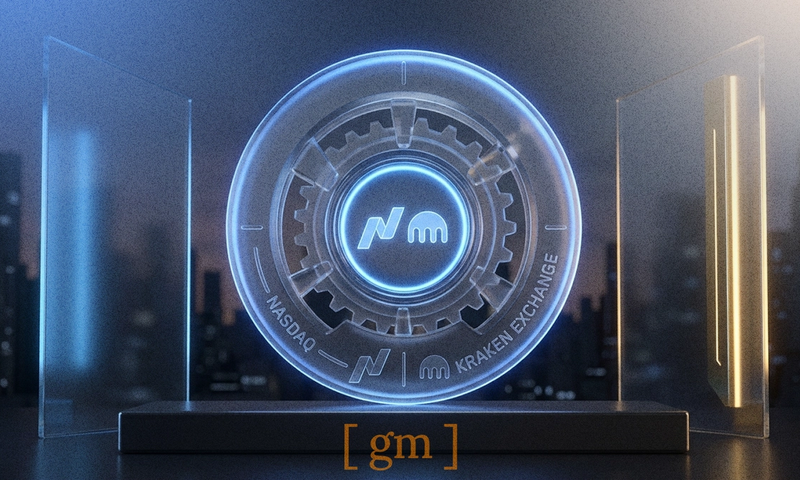
Wall Street's oldest guard just made its biggest move yet into crypto's tokenization race, and it's designed to solve the exact problem that's had CEOs threatening lawyers. Nasdaq's venture arm is investing $100 million in Payward, the parent company of crypto exchange Kraken, to build the infrastructure for trading tokenized stocks. The deal values Payward at roughly $21 billion and targets a launch in the second quarter of 2027.
What the deal is
The investment, made through Nasdaq Ventures, deepens a partnership first announced in March around "Nasdaq Equity Tokens," or NETs, blockchain-based versions of publicly traded stocks. Under the arrangement, Kraken's platform will act as a distribution channel for tokenized Nasdaq-listed stocks, connected to Payward's existing xStocks ecosystem. Payward will also adopt Nasdaq's market-surveillance technology across its trading venues, covering crypto, equities, tokenized equities, futures, and options, part of Kraken's broader push to become a multi-asset exchange, not just a crypto one. Notably, the tokens are not live today; the whole framework is a Q2 2027 target.
The crucial difference: real shareholder rights
Here's the detail that matters most, and it's what separates this from the tokenized-stock products already causing controversy. Nasdaq Equity Tokens would confer shareholder voting rights equivalent to those attached to shares on Nasdaq's traditional exchange, and the framework is explicitly designed to put public companies "at the center of ownership rights, transparency, and governance."
That's a direct contrast to the model that's drawn fire. Just last week, AMC's CEO publicly blasted Robinhood over its tokenized AMC shares, which give holders economic exposure to a stock's price but no ownership and no voting rights, and which Robinhood offered without the company's consent. The Nasdaq-Kraken approach flips that: it's issuer-sponsored, rights-preserving, and built inside existing regulatory frameworks, precisely to avoid the "synthetic shares nobody approved" problem. It also follows the SEC's approval of a Nasdaq rule change permitting certain securities to trade and settle in tokenized form, giving the effort a regulatory foundation Robinhood's offshore structure lacks.
Why Wall Street wants this
The pitch is about fixing plumbing, not chasing hype. As Payward co-CEO Arjun Sethi put it, more than $2 trillion in stock trades run through the US clearing system every day, and traditional settlement still involves waiting periods. On-chain settlement, the argument goes, removes that wait and enables markets that never close. Nasdaq's leadership framed the bet in infrastructure terms: the next era of markets, they said, will be defined by how efficiently capital and assets move across the financial system, with the collaboration run through Nasdaq's "Digital Liquidity Networks" division focused on around-the-clock market infrastructure.
This is one of the clearest signals yet that tokenized stocks are moving from crypto experiment to mainstream financial infrastructure, and that the model is being contested in real time. On one side sits the fast, permissionless, "own the price not the share" approach spreading through crypto (Robinhood, StonkFun, and the memecoin-paired tokens that dragged AMC's CEO into a public fight). On the other, Nasdaq and Kraken are building the slower, issuer-sponsored, rights-intact version with Wall Street's blessing and regulatory cover. When a pillar of traditional finance like Nasdaq commits $100 million and its surveillance backbone to the second model, it suggests the future of tokenized equities may look less like a memecoin casino and more like the regulated market it's meant to modernize, just on rails that never close. The 2027 timeline means the real test is still years away, but the direction is set.