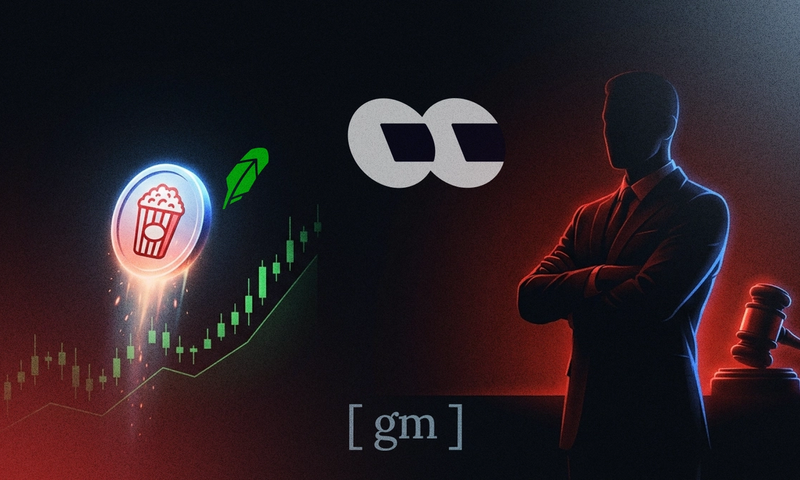
A single memecoin trade this week captured everything wild, lucrative, and legally messy about crypto's newest craze: tokenized memecoins on Robinhood's blockchain. One trader turned $1,491 into more than $1.2 million in under 12 hours, the token in question dragged a Fortune 500 CEO into a public fight with securities lawyers, and it all ran through an app that lets people gamble on memecoins in seconds. Here's the whole strange saga.
The 810x trade
According to on-chain tracker Lookonchain, crypto influencer Frank (frankdegods) spent $1,491 to buy 11 million tokens of a memecoin called MEME. Roughly 11 hours later, that stake was worth over $1.2 million, an 810x return, as the token's market cap exploded past $100 million with gains reported in the hundreds of thousands of percent. Frank posted the position openly, along with a bit of trolling ("CNBC starts their morning coverage in 4 hours") and a popcorn emoji, as the trade went parabolic.
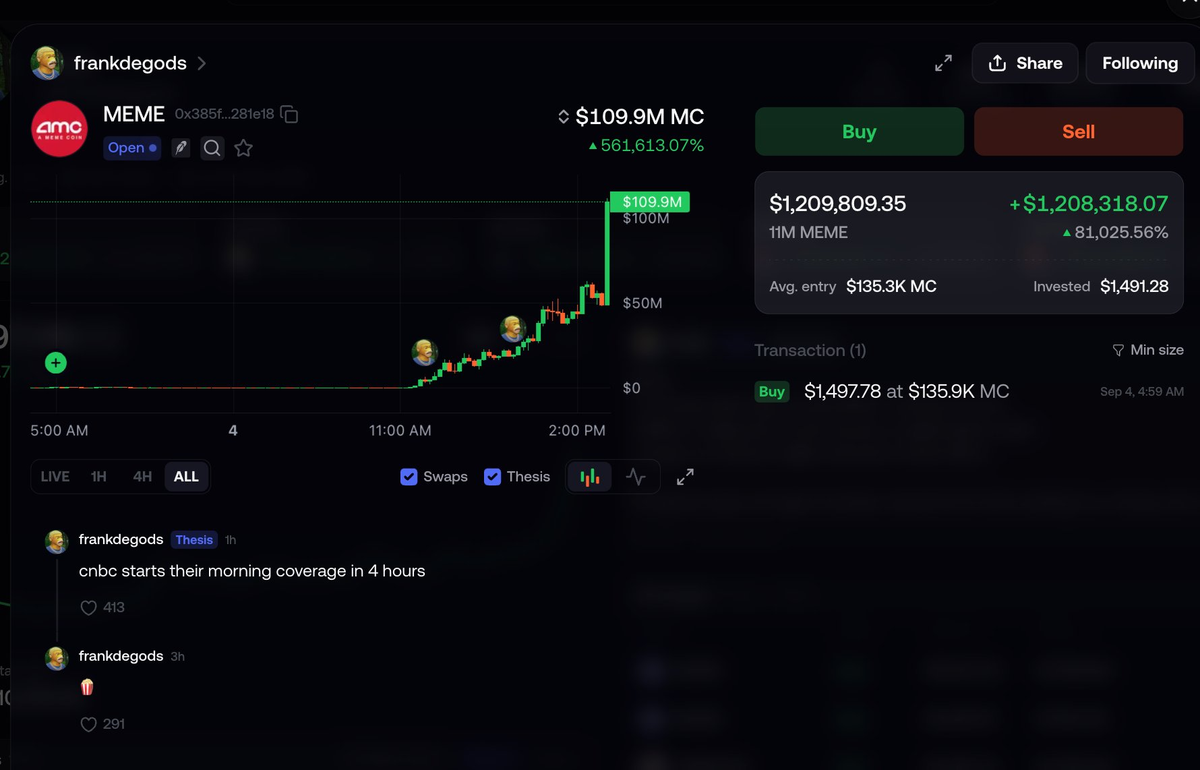
It's the kind of screenshot that fuels an entire market: a four-figure bet becoming a seven-figure windfall in an afternoon. But the more important question is why this particular token caught fire, and that's where it gets interesting.
The "AMC" memecoin and the CEO who fought back
The MEME token wasn't random. It rode a pun: $AMC reinterpreted as "A Meme Coin," complete with AMC's movie-theater branding and popcorn imagery. The frenzy intersected with a genuinely consequential development, Robinhood's tokenized "Stock Tokens," which include a blockchain product tracking AMC Entertainment's shares.
That's what pulled AMC CEO Adam Aron into the fray. In a blistering post on X, Aron said Robinhood was behind tokenized "Stock Tokens" for AMC and roughly 190 other companies, and made clear AMC wanted nothing to do with it: "We have no connection to this at all, and do not condone it in any way." He called the practice "contemptible" and "outrageous," demanded to know how it could be legal, and said AMC would immediately have its outside securities counsel examine the matter.
The real issue: what these tokens actually are
Aron's outrage points at a legitimate and growing problem in crypto: products that carry a company's name without the company's involvement, and without the rights investors might assume. Robinhood's Classic Stock Tokens are derivative contracts that give economic exposure to a stock's price, not actual ownership. Holders get no shares and no shareholder rights like voting. Robinhood says it holds the underlying assets through a US-licensed institution and offers the tokens in Europe under MiFID II rules, explicitly not to US persons, but the tokens aren't registered under US securities laws, which is exactly what set Aron off.
This isn't the first time. OpenAI previously disavowed Robinhood tokens linked to its private shares, saying they weren't OpenAI equity and hadn't been endorsed. The pattern is the same each time: a token appears bearing a well-known name, the named company says "that's not us," and ordinary buyers are left to figure out what they actually own. When a memecoin then piggybacks on that confusion, as MEME did with the "A Meme Coin" gag, the line between a real financial product and a pure gamble dissolves entirely.
The engine behind the frenzy: FOMO and tokenized memecoins
The trade ran through FOMO, an app that has become the face of a booming, controversial trend: making memecoin speculation as frictionless as possible. Apps like FOMO and Robinhood's wallet let users buy memecoins in seconds, and reporting has noted that buying memecoins this way can even sidestep some card-network crypto rules by classifying the tokens as "collectibles." The mechanics that make 810x trades possible are the same ones that make them dangerous: when only a few million dollars sit in a token's liquidity pool, even small buys trigger triple-digit percentage swings. Those swings create screenshots, screenshots attract new buyers, and the cycle feeds itself, until it doesn't.
The sobering reality check
For every Frank turning $1,491 into $1.2M, the data shows an ocean of losers. A recent on-chain analysis of FOMO's own traders found that only about 6% were profitable, with the median trader down and the group collectively losing over a billion dollars, worse odds than a casino. The viral windfall screenshots are real, but they're the rare exception that lures everyone else in. That's the uncomfortable core of the tokenized-memecoin boom: it's engineered virality, where a handful of life-changing wins get amplified across social media while the far larger population of losers stays silent.
The AMC saga adds the final twist. A memecoin built on a movie chain's name, trading on a brokerage's blockchain, tracking a stock the company itself disowns, now with securities lawyers circling. It's simultaneously a story about a legendary trade, a legal gray zone in tokenized stocks, and a market where the most frictionless way to gamble has never been more popular, or more perilous.
This is educational information, not financial advice. Memecoins carry an extremely high risk of total loss. Prices and figures move constantly. Always do your own research.