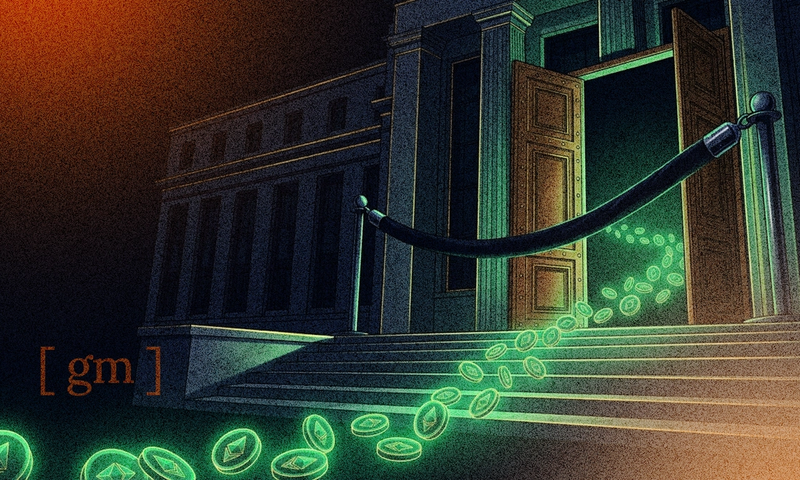
The Securities and Exchange Commission spent the late 2010s burying the ICO — enforcement action by enforcement action, until public token sales in the US were functionally extinct. This month, according to fresh reporting, the same agency is expected to finish building their legal replacement.
The mechanism is the "innovation exemption," the centerpiece of Chair Paul Atkins' Project Crypto agenda, first announced in July 2025. In plain terms: eligible firms would be allowed to issue and trade digital tokens without completing the full securities registration process — the wall that made compliant token sales prohibitively expensive for almost everyone. Atkins has been open about the demand side, telling a policy audience last summer that firms from Wall Street to Silicon Valley are "lined up at our doors" to tokenize. The design he sketched then included periodic reporting to the Commission and vetted, whitelisted participants — a supervised sandbox, not a free-for-all.
What it actually unlocks. Two things, and they're different. First, token issuance — capital raising with a token, the activity the ICO era pioneered and enforcement ended. Second, tokenized equities: blockchain versions of listed stocks trading around the clock, including weekends. Under the framework outlined in pre-announcement coverage, those equity tokens are expected to represent economic exposure to the underlying shares rather than direct legal ownership — which may mean no voting rights, no proxy materials, and open questions about dividends and corporate actions.
That design choice is the fight. Critics point out the US is about to run two parallel rails for the same assets. One rail — the Nasdaq and DTCC model – keeps the entire scaffolding of securities law and simply appends a token to the settlement chain; the SEC approved Nasdaq's version in March, and DTCC ran its first live production trades of tokenized securities just this week, with a broader rollout planned for October. The other rail, the innovation exemption, explicitly doesn't have to preserve that scaffolding. Same company, two markets, different rights. Investor-protection advocates call that a downgrade dressed as innovation; the industry calls it the only way on-chain markets ever get built.
The market isn't waiting for either side. Retail-focused tokenized stocks have grown from a rounding error at the end of 2024 to a market capitalization above $6.4 billion by mid-June – almost all of it offshore, precisely because it couldn't pass through US rules. The exemption is what brings that model home.
Now the irony, because today is the day for it. As this framework nears the finish line, the House is in New York holding a field hearing on the CLARITY Act , the market-structure bill stuck in the Senate with fading odds. Notice the pattern: the spot ETFs run on a joint SEC-CFTC interpretive release; token sales are returning via an exemption; the entire US crypto framework is being assembled from administrative decisions that a future commission could unwind on any Tuesday. The industry is getting everything it asked for — as rented certainty. CLARITY was supposed to convert it into owned certainty. That conversion is the part still failing.
The European angle: the EU took the cautious road here — the DLT Pilot Regime for tokenized securities is deliberately small, and MiCA doesn't cover security tokens at all, leaving them under traditional securities law. If the US exemption ships, Europe will face the uncomfortable question its exchanges already know from stablecoins: strict rules at home mean the interesting products live offshore, one app-store tap away. Expect pressure on Brussels to widen its pilot – and expect European platforms to lobby loudly for it.
What's next: the exact text and effective date, who qualifies as "eligible," and the milestone worth circling — the first fully legal public token sale in the United States since the ICO era. When that happens, it's a front-page story. You'll have read the preview here.