One of the largest crypto exploits of the year just hit a piece of Bitcoin infrastructure most people never think about, and it's playing out in the strangest way: the attackers who drained roughly $320 million say they're the good guys, and they're negotiating the return of the money in public, one blockchain message at a time.
What happened
On September 6, roughly 4,000 BTC, worth about $320 million, was withdrawn from the federation wallet backing Blockstream's Liquid Network, a Bitcoin sidechain. The wallet had held around 4,200 BTC, meaning the withdrawal drained close to 95% of the network's reserves in a single transaction. Liquid paused all network activity, and exchanges suspended L-BTC deposits and withdrawals in response.
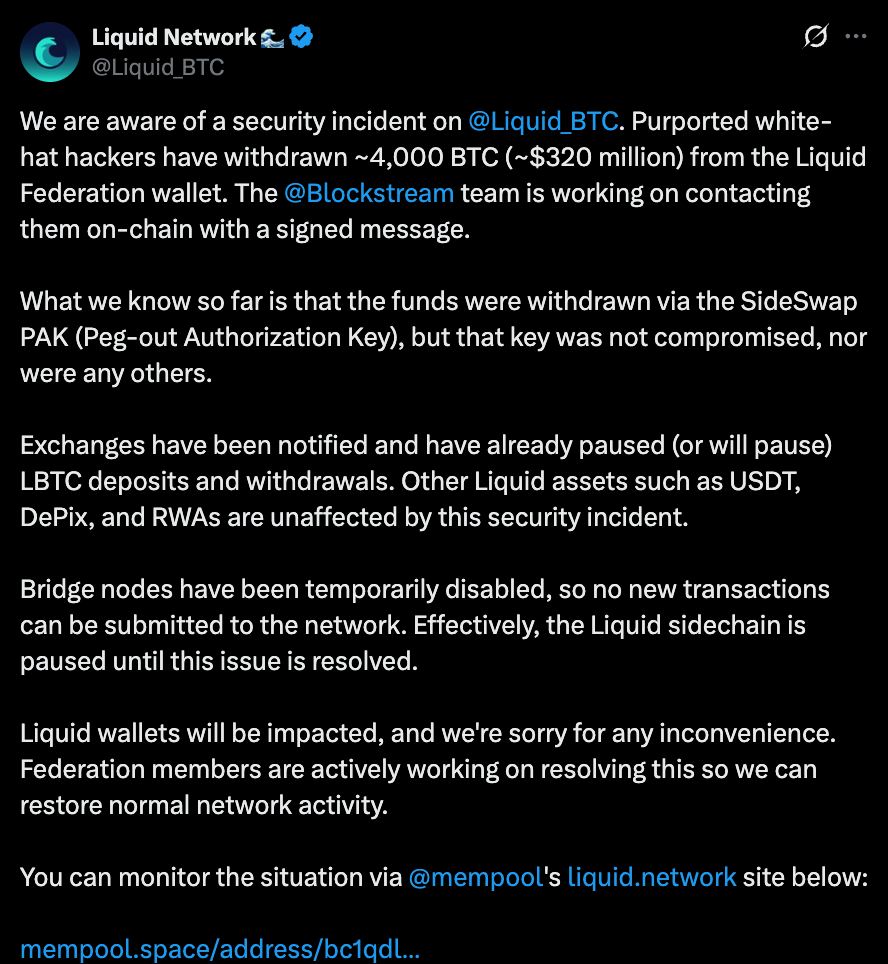
First, the essential clarification: Bitcoin itself was not hacked. Its base layer, cryptography and proof-of-work consensus were untouched, and BTC's price held steady around $80,000. Liquid Network is a sidechain, a separate blockchain linked to Bitcoin that lets exchanges and institutions make faster, more private transfers. Users lock real BTC and receive "Liquid Bitcoin" (L-BTC) in return, with a federation of 80+ exchanges and firms securing the underlying coins. It was that federation's reserve, the backing for every L-BTC, that was drained.
How it happened: no keys were stolen
This is the part that matters. The attacker didn't steal any private keys or break any hardware. According to Liquid, the funds moved through the SideSwap "Peg-out Authorization Key", but that key was not compromised, and neither were any others. Blockstream attributed the incident to a software bug in Elements, the protocol that underpins Liquid, at the node level in its transaction software. In other words, the federation's own signing process authorized the withdrawal with perfectly valid signatures, because a flaw in the code allowed a transaction that should never have been possible. It's the same lesson echoing across crypto this year: catastrophic losses increasingly come from flawed code and configuration, not stolen keys.
The twist: "we are whitehats"
Here's what makes this incident genuinely unusual. The attackers left a message directly on the Bitcoin blockchain reading, in essence, "we are whitehats. contact us on chain." A white-hat is an ethical hacker who exploits a flaw before criminals can, then typically returns the funds in exchange for a fee. Blockstream confirmed it is working to contact the parties through on-chain signed messages, and by September 7, the purported white-hat had reportedly asked whether returning "most" of the funds to the federation address would be acceptable.
But treat the "white-hat" label with caution: Blockstream has not independently verified the claim, no funds had been confirmed returned at the time of writing, and "we're white-hats" is also a convenient thing to say while holding $320 million. The negotiation is happening in the open, message by message, which makes this one of the more transparent, and bizarre, standoffs crypto has seen.
Why it matters
Beyond the headline number, this incident is a sharp reminder about custodial and infrastructure risk. When you hold L-BTC, or trust any bridge, sidechain, or exchange to hold your Bitcoin, you inherit that system's software and operational risk: a bug you can't see and didn't cause can freeze or drain funds you thought were safe. That's the enduring argument for self-custody where it's practical. It also fits a stark 2026 pattern: per one industry report, infrastructure and operational vulnerabilities caused only about 15% of crypto incidents this year but 76% of the total money lost, because when a bridge or federation breaks, it breaks big. Whether the Liquid hacker turns out to be a genuine white-hat or simply a thief with good PR, the episode guarantees one thing: every federated bridge and sidechain in crypto is about to get a very uncomfortable security review.
This is a developing story; details and the status of the funds may change. This is educational information, not financial or security advice. Always verify through official channels.