If you use, hold, or build anything crypto-related in Europe, one law now governs the ground you stand on: MiCA. It's the reason some exchanges operate freely across 27 countries while others — including the biggest exchange on Earth — have been shut out. This guide explains what MiCA actually is, in plain language, with no legal background assumed.
What does MiCA stand for?
MiCA is the Markets in Crypto-Assets Regulation — a European Union law that creates a single, unified rulebook for crypto across all 27 member states. It has been rolling into force since 2024, following a transitional period that ended on July 1, 2026.
The problem MiCA was built to solve
Before MiCA, a crypto company wanting to operate across Europe faced 27 different national regimes — 27 sets of rules, 27 registrations, 27 regulators. It was slow, expensive, and full of grey areas where firms operated in a legal fog.
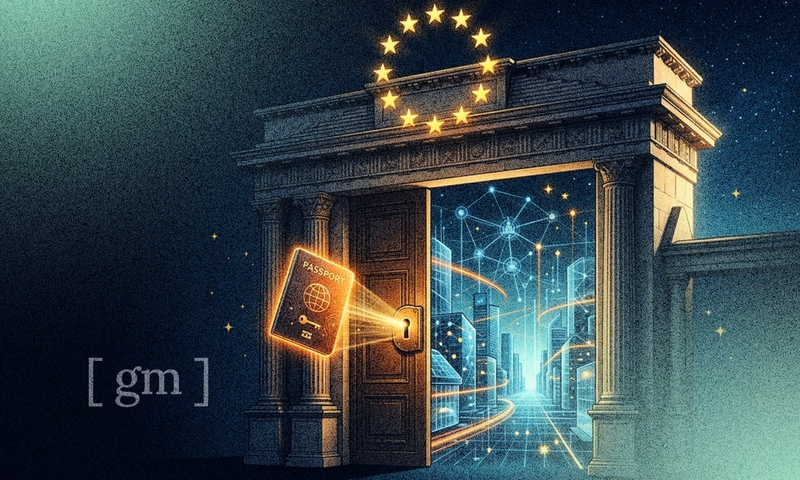
MiCA replaced that patchwork with one system built on a single powerful idea: the passport. Get authorized as a Crypto-Asset Service Provider (CASP) in any one member state, and you can offer your services across the entire EU. One license, 27 countries. This is the same mechanism the EU has long used for banks and traditional financial firms.
Who does MiCA apply to?
MiCA covers what it calls Crypto-Asset Service Providers — the businesses in the middle of the crypto economy, including exchanges, custody and wallet providers, brokers and trading platforms, and stablecoin issuers. Ordinary individuals holding crypto aren't licensed under MiCA, but they're affected by it directly: the platforms they use must be authorized to serve them legally.
The three things MiCA regulates most tightly
1. Exchanges and service providers. Any platform offering crypto services to EU residents needs a CASP license, which requires meeting standards for capital, custody of customer assets, security, and governance.
2. Stablecoins. MiCA imposes some of its strictest rules here. Issuers of euro- or dollar-pegged stablecoins must hold proper reserves and meet transparency requirements. Tokens that failed to comply were delisted from EU venues — while compliant issuers kept their access.
3. The people in charge — the "fit and proper" test. This is MiCA's sharpest and least understood tooth. Regulators don't just assess a company's paperwork; they assess whether its owners and senior managers have the integrity, reputation, and clean track record to run a licensed financial business. A perfect application can still be rejected if the regulator doesn't trust the people behind it.
MiCA in action: the Binance lockout
The clearest demonstration of MiCA's power came in July 2026. Binance, the world's largest crypto exchange by volume, lost the right to offer new services to EU users because it failed to secure a CASP license before the transitional deadline. Reporting indicated the sticking point wasn't its filing but the fit-and-proper test — its history of penalties and questions around its ownership. Of more than 3,000 crypto firms in Europe, only around 210 secured authorization; rivals like Coinbase, Kraken, and OKX passed while Binance did not. The lesson: in MiCA's Europe, being the biggest buys you nothing if you can't clear the integrity bar.
What MiCA means for you
If you hold crypto in the EU: check that your exchange holds a MiCA license. Using an unlicensed platform can mean sudden service restrictions, as millions of Binance users learned.
If you build in crypto: MiCA is a cost and a moat. Getting licensed is demanding, but once you have the passport, you reach 450 million people through one authorization — and your unlicensed competitors legally can't.
If you're in Central & Eastern Europe: MiCA increasingly sets the standard your market aligns with. For high-adoption countries like Ukraine, understanding MiCA is understanding the direction regional crypto rules are heading — licensed platforms, reserve-backed stablecoins, and integrity checks on who runs them.
Why the world is watching MiCA
MiCA is the first comprehensive crypto framework from a major economy, and it's now the reference point everyone measures against. The United States is still trying to pass comparable market-structure legislation (the CLARITY Act) and building rules by agency action (the SEC's Regulation Crypto) — years behind Europe on process. Whatever its flaws, MiCA proved a major economy can write enforceable crypto rules and make even the largest players comply. That's why, when people argue about how to regulate crypto anywhere in the world, the conversation now starts with Europe.
The bottom line
MiCA turned Europe from a patchwork into a single crypto market with one rulebook, one license, and one passport — enforced strictly enough to shut out the world's biggest exchange. Love it or hate it, it's the most important crypto law in the world right now, and the template others are copying.