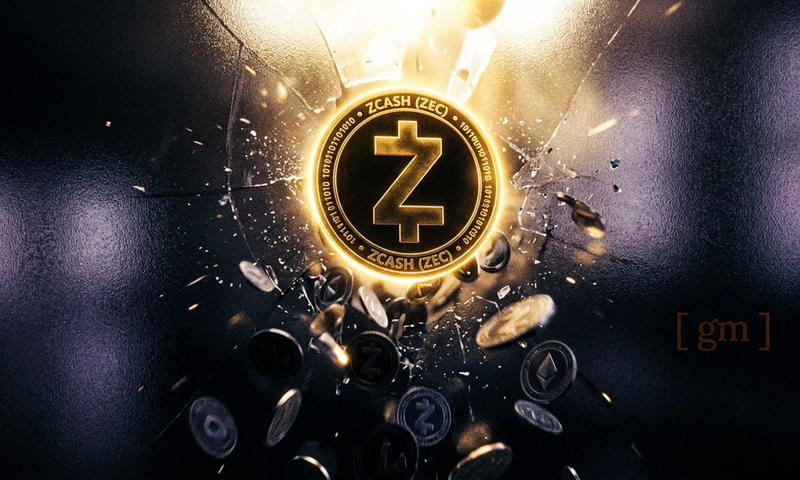
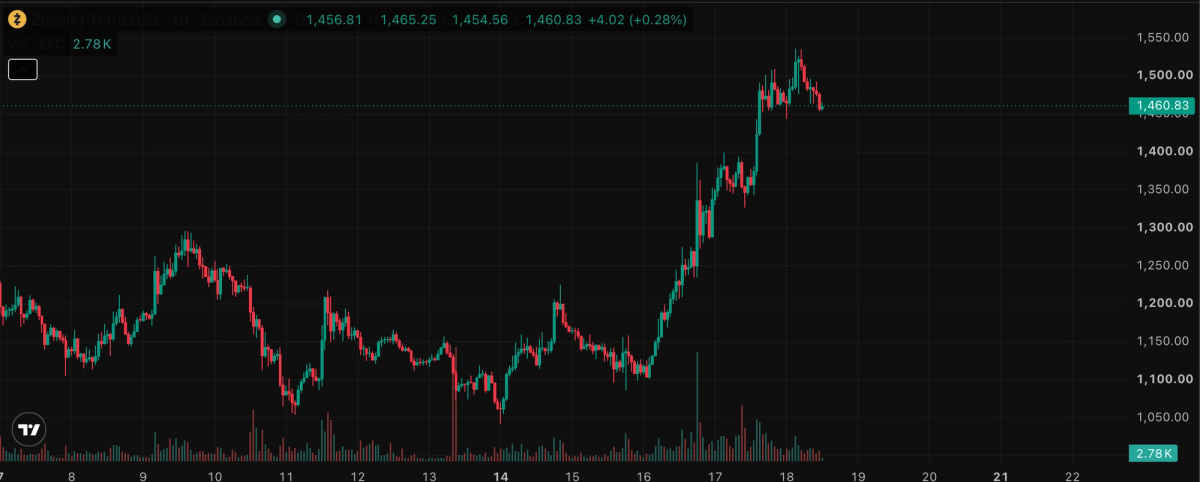
The privacy coin comeback that started this summer just hit a new peak, and this time a top-tier crypto fund lit the fuse. Zcash (ZEC) surged roughly 25% to a record high near $1,550, dramatically outpacing a nearly flat Bitcoin, after Paradigm co-founder Matt Huang publicly disclosed that his firm owns ZEC and framed it as a natural privacy companion to Bitcoin. It's a striking institutional endorsement for an asset class that spent years treated as untouchable.
What happened
On Thursday, ZEC jumped as much as 23% over 24 hours to an intraday high around $1,388-$1,389, a record, trading near $1,369 during the rally. The move stood out for its divergence from the rest of the market: while Zcash soared, Bitcoin gained less than 1% (around $76,000) and Solana rose about 3%. When one asset triples the market's move on its own catalyst, that's a sign of asset-specific demand, not just a broad tide lifting everything.
The rally was severe enough to punish those betting against it: Zcash alone accounted for $56 million of roughly $345 million in crypto liquidations, as short sellers were forced to buy back into the surge.
The catalysts: Paradigm plus governance
Two things drove the move. First and biggest: Paradigm co-founder Matt Huang disclosed that the firm holds ZEC and described Zcash as "a private complement to Bitcoin." Paradigm is one of crypto's most respected venture firms, so a public position and endorsement from its co-founder carries real weight, it signals to other institutions that privacy is an investable thesis, not a regulatory third rail. (Paradigm had already backed Zcash's development lab earlier in 2026, alongside a16z and Winklevoss Capital, so the conviction isn't new, but the public disclosure crystallized it.)
Second, Zcash holders approved community governance upgrades, including faster block times and a shift toward Bitcoin-style halvings, changes designed to strengthen the network's economics and scarcity narrative. Together, an institutional stamp of approval and a protocol upgrade gave the market two reasons to buy at once.
The bigger picture: privacy goes institutional
Zcash's run is remarkable in context. The token is up roughly 168% over the past month, part of an extraordinary recovery that has transformed it from an overlooked, exchange-shunned asset into one of crypto's standout performers of 2026. The turnaround has been building all year: a US SEC investigation into the Zcash Foundation closed without action in early 2026, removing a regulatory cloud; record amounts of ZEC moved into shielded (private) pools; and institutional interest grew through the year, with Multicoin Capital earlier calling Zcash "the cleanest expression of the privacy thesis."
The Huang endorsement fits a narrative gaining traction: that in an era of increasing financial surveillance, optional privacy is a feature, not a liability, and Zcash, which lets users choose between transparent and shielded transactions, is its most mature implementation. What was once crypto's regulatory pariah is being repriced as a legitimate complement to Bitcoin.
The caution
Enthusiasm needs a cold-water chaser, especially at a record high. ZEC is notoriously volatile, and a 23% single-day spike driven partly by a short squeeze can reverse just as violently once the trapped shorts are cleared. Analysts have flagged bearish momentum divergence breaking $1,500 all-time-high resistance zone, with support levels noted far below (around $800, and $500 as a deeper demand region). Privacy coins also carry regulatory risk that most assets don't, they've faced delisting pressure on various exchanges over the years, and a shift in political winds could bring scrutiny back. This is among the higher-risk corners of an already-risky market, and buying an asset at an all-time high after a parabolic month is precisely when caution matters most.
Zcash reaching a record on a top VC's endorsement is a milestone for the whole privacy-coin category. For years, "privacy coin" was shorthand for regulatory danger and exchange delistings; now one of crypto's most credible investors is publicly holding one and calling it Bitcoin's complement. Combined with a pending Grayscale ETF and growing institutional accumulation, it suggests the market's definition of "investable" is genuinely expanding to include financial privacy. Whether ZEC can hold gains at these heights is an open question, and the volatility cuts both ways, but the deeper signal is clear: the privacy thesis has gone from fringe to funded.
This is educational information, not financial advice. Privacy coins are especially volatile and carry elevated regulatory risk. Prices cited are as of publication and will change. Always do your own research.