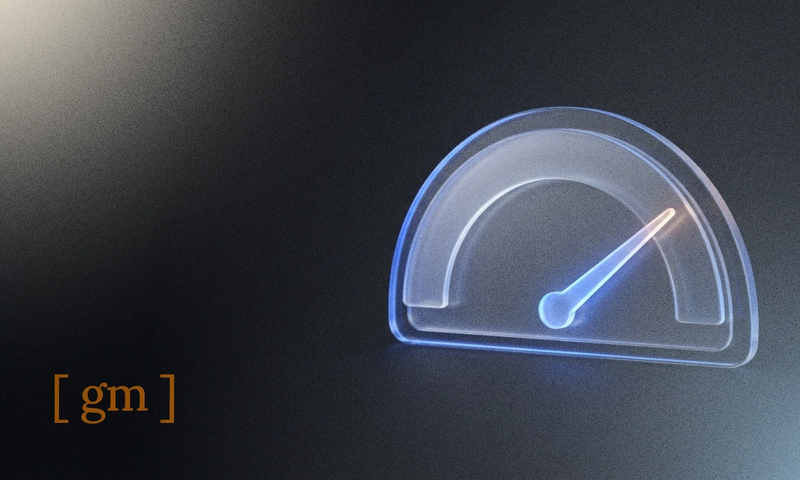
The crypto market's mood has done a complete 180. In less than two weeks, the widely watched Crypto Fear & Greed Index has rocketed from 27, deep in "fear", all the way to 74, firmly in "greed," as Bitcoin surged from below $68,000 toward $80,000. It's one of the fastest sentiment reversals in the index's history. And it comes with an unsettling piece of context: the last time the gauge was this high, the market suffered its worst crash on record just days later. Here's what that actually means, and, crucially, what's different this time.
What the Fear & Greed Index is. For anyone new to it: the Crypto Fear & Greed Index is a simple 0-to-100 gauge of market emotion. Zero is "extreme fear" (everyone's panicking and selling), 100 is "extreme greed" (everyone's euphoric and buying). It blends several inputs, most heavily Bitcoin's volatility and trading momentum, along with social media activity, Bitcoin's market dominance, and Google search interest. Anything above 50 counts as greed. One important caveat: it measures what traders are doing right now, it's a mood ring, not a crystal ball. It tells you the temperature, not the forecast.
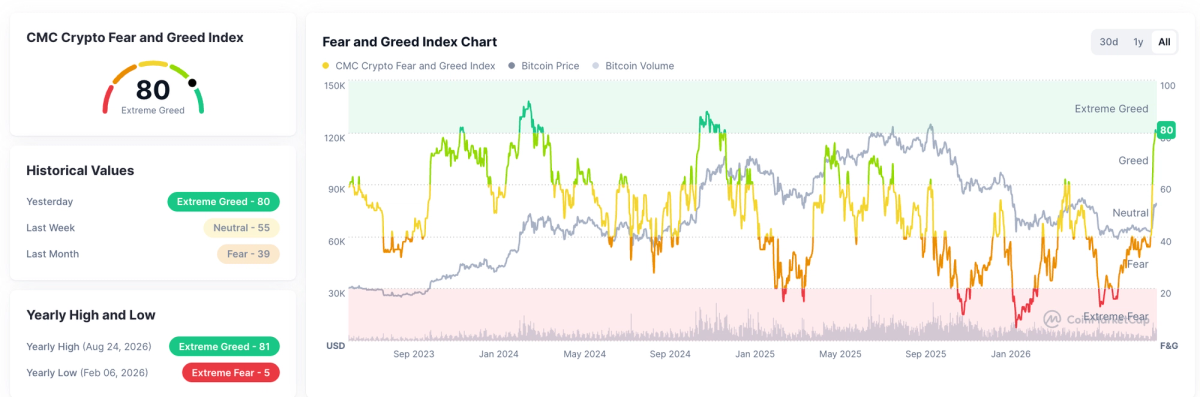
The unsettling comparison. The index hit 74 this week. The last time it printed that high was October 5, 2025. Five days later, the market tumbled in a cascade that forced roughly $19 billion of leveraged positions to close in a single session, still the largest such liquidation event on record. That's why some traders are nervous: elevated greed has historically signaled a market that's overheated and vulnerable to a sharp reversal, because when everyone has already bought, there are fewer buyers left to push prices higher, and a lot of leveraged bets primed to unwind.
Just how fast this flip happened. The speed is the remarkable part. The index spent an extraordinary stretch in pessimism, below 50 for over 100 consecutive days through August 19, one of the longest gloom streaks in its eight-year history, bottoming at 25 ("extreme fear") on August 6. Then, in days, it flipped to greed. Sentiment that negative for that long, snapping back that fast, is exactly the kind of violent mood swing that makes seasoned traders cautious about froth.
But here's the key difference: the demand isn't the same. This is the part that separates panic from analysis, and it cuts against a simple "October is happening again" read. In the run-up to October's crash, the rally was backed by enormous institutional buying, weekly spot Bitcoin ETF inflows topped $3 billion, and US investors were accumulating aggressively. This time, that demand is materially weaker: recent weekly ETF inflows have been closer to $1 billion, and one closely watched gauge of US buying pressure (the Coinbase Premium) has been notably absent. That's a double-edged sword. On one hand, a rally not driven by frothy institutional FOMO has less of that specific fuel to flush out. On the other, it means this move has been powered substantially by a short squeeze, forced buying from bearish traders, rather than fresh conviction money, which raises its own questions about staying power.
What this means for you. A few grounded takeaways. High greed is not a sell signal by itself, markets can stay greedy and keep climbing for a while; the index has been wrong as a precise timing tool many times. But it is a signal to check your own behavior: greed is when people over-leverage, chase pumps, and buy tokens they don't understand because everything's going up, exactly the mistakes that get punished hardest when the reversal comes. The lesson from October isn't "sell everything." It's that the moment sentiment is euphoric is the moment to manage risk deliberately, size positions sensibly, be skeptical of parabolic moves in low-quality tokens, and never use leverage you can't survive being wrong on.
The near-term test. Markets are watching Friday, when new Federal Reserve Chair Kevin Warsh delivers his first major keynote at the Jackson Hole symposium, an event that could set the macro tone and either extend the risk-on mood or puncture it. Combined with stretched sentiment, it makes the next few sessions a genuine test of whether this rally has legs or has gotten ahead of itself.
What to watch: whether ETF inflows strengthen to confirm real demand (bullish) or stay tepid (cautionary), whether greed tips into "extreme greed" above 80 (historically the frothiest, riskiest zone), the Jackson Hole reaction, and whether leverage in the system keeps building, the fuel for any sharp reversal.