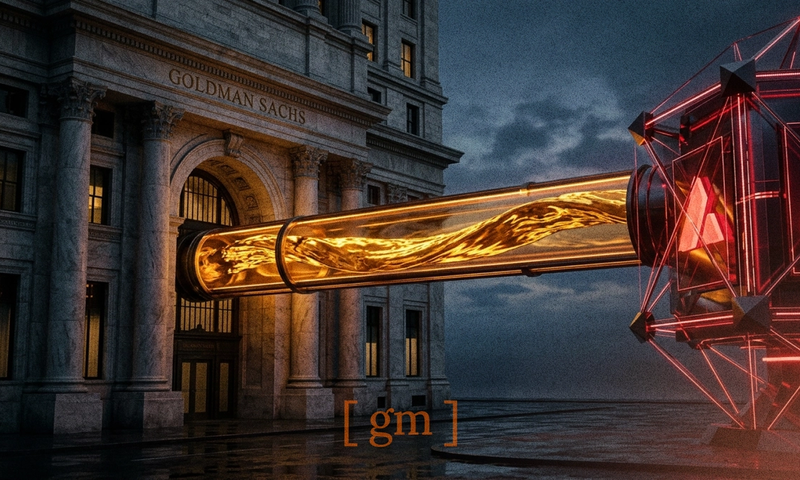
Another Wall Street giant just wired itself into crypto's plumbing, but it did it in a way that's easy to misunderstand. Goldman Sachs is making its roughly $100 billion flagship Treasury fund available to institutional crypto firms through a blockchain network built on Avalanche. Crucially, Goldman did not tokenize the fund, it added a new distribution rail. That distinction is the whole story, and it signals where institutional crypto adoption is actually heading.
What Goldman did
Goldman Sachs is offering its Financial Square Treasury Instruments Fund (FTIXX), which holds roughly $100 billion in assets, through Lynq, a real-time settlement network used by digital-asset firms. Lynq runs on a private, permissioned Avalanche Layer 1 blockchain, and connects more than 30 institutional players including Wintermute, Galaxy, B2C2, FalconX, and Fireblocks. Eligible US participants access the fund through the SEC-registered broker-dealer tZERO Securities.
FTIXX is the first outside fund offered on Lynq, previously the network carried just one investment product. The practical use case is specific and clever: it lets crypto trading firms park idle cash between trades in a safe, yield-bearing Treasury fund while keeping it on real-time settlement rails, so money that would otherwise sit dead can earn a return without leaving the workflow.
The key nuance: distribution, not tokenization
Here's the part most headlines will blur, and it genuinely matters. Rivals like BlackRock (with BUIDL) and Franklin Templeton (with BENJI) approached on-chain finance by tokenizing their funds, creating blockchain-native versions of the product. Goldman took a different path: FTIXX stays a completely normal, traditional Treasury fund. Goldman didn't build a new blockchain product at all. Instead, Lynq acts as a new "front door", a settlement rail that lets crypto-native firms access the existing fund through blockchain infrastructure they already use daily.
The distinction is strategic. Tokenizing a fund is complex, involves new legal and regulatory questions, and creates a separate on-chain asset. Goldman's approach sidesteps all of that: it plugs a proven, $100 billion Wall Street product into crypto settlement rails without changing the fund itself. It's a lower-risk, faster way for a conservative institution to reach crypto clients, and it may prove to be a template other cautious giants copy.
Why this matters for Avalanche and crypto
For Avalanche, landing a Goldman Sachs product is a significant validation. Lynq migrated to a permissioned Avalanche Layer 1 in April 2026 for better control over validators, privacy, and performance, and tying that infrastructure to a major bank's fund and a network of 30+ institutional firms strengthens Avalanche's positioning as institutional-grade infrastructure. (Whether it translates into broader on-chain activity depends on how much cash actually flows through Lynq after launch, an open question worth watching.)
For crypto more broadly, it's another brick in a fast-building wall. In just recent weeks, Nasdaq invested $100M in Kraken's parent, S&P Global bought a crypto-security firm, Deutsche Bank moved toward Bitcoin custody, the Fed drafted stablecoin rules, and now Goldman is routing a $100B fund onto blockchain rails. The pattern is unmistakable: traditional finance isn't asking whether to engage with crypto infrastructure anymore, it's competing over how. And Goldman's "distribution not tokenization" model shows there's more than one road in.
Why it matters
The significance here isn't that Goldman launched a crypto product, it deliberately didn't. It's that one of the world's most conservative financial institutions decided its $100 billion flagship Treasury fund belongs on blockchain settlement rails, accessible to crypto-native firms. That's a quiet but powerful signal: blockchain infrastructure has matured enough that a bank like Goldman sees it as a legitimate distribution channel, not an experiment. For the institutional crypto firms that can now put idle cash to work in a Goldman fund between trades, it's a genuinely useful bridge between traditional finance and crypto rails. And for anyone tracking the big picture, it's confirmation that the merger of Wall Street and blockchain is happening, not through flashy tokenized tokens, but through the unglamorous plumbing where real money actually moves.
This is educational information, not financial or investment advice. Always do your own research.