MetaMask, the most widely used self-custody crypto wallet, has started taking Ethereum validators offline after disclosing a security incident affecting part of its staking infrastructure. The company says users' wallets face no immediate threat. But as of this writing, many of the most important details remain unconfirmed, and in a fast-moving security situation, separating what's known from what isn't is the most useful thing we can do. Here's a clear-eyed breakdown.
What MetaMask has confirmed
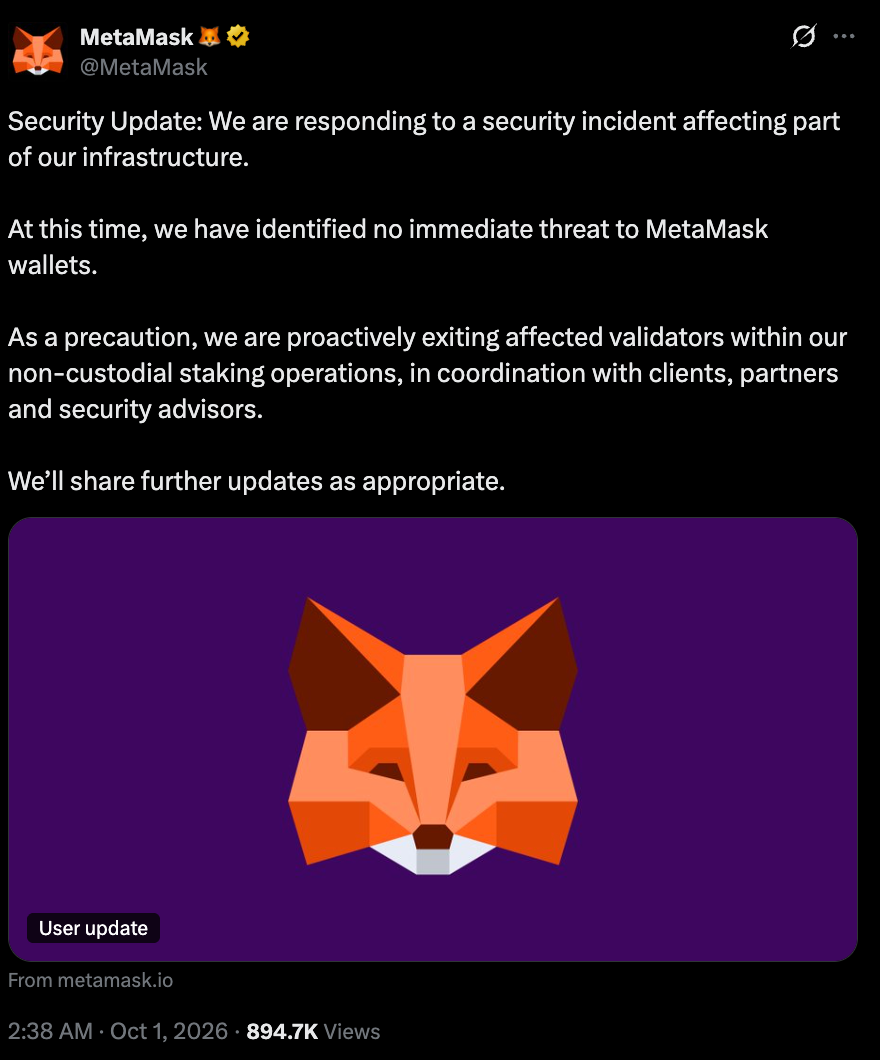
On October 1, MetaMask disclosed a security incident in part of its infrastructure and began exiting the affected Ethereum validators. The company's key reassurance: client withdrawal keys are outside its control, meaning users retain the ultimate authority over their funds. MetaMask stated that user wallets face no immediate threat.
Staking infrastructure provider Lido, whose system interacts with validators like these, warned that the validator exits could lead to lost staking rewards and potential downtime penalties, a practical consequence for affected stakers even if funds themselves aren't lost.
What's NOT confirmed (and why that matters)
Here's where responsible reporting requires caution. As of October 1, MetaMask's notice does not disclose:
- the cause of the incident or any confirmed attacker,
- a list of the affected validators,
- the total amount of ETH staked or affected,
- the number of affected customers,
- the exact time of discovery, or
- any confirmed loss of funds.
In other words, the central facts that would let anyone calculate the real impact simply aren't public yet. Any report claiming to know precisely how much ETH is at risk or exactly what happened would be, as one outlet put it plainly, "filling those gaps with conjecture." We're not going to do that. What we can say is that MetaMask identified a problem, is responding by taking validators offline, and maintains that user wallets aren't directly threatened.
Understanding what's actually happening
To make sense of this, a quick primer. When you stake ETH, your funds help secure the Ethereum network through "validators." Exiting a validator isn't instantaneous, it's a multi-step process: the validator must first exit the active set, then the staked ETH can be withdrawn, and if the staker wants to keep earning, a replacement validator has to be launched. Those are three separate events that happen over time, not at the flip of a switch. So even in the best case, there's a transition period during which affected stakers may miss rewards or face the downtime penalties Lido flagged.
The reassuring structural point is the one MetaMask emphasized: because this is self-custody infrastructure, the withdrawal keys that ultimately control the funds sit with users, not with MetaMask. That's a meaningful difference from a custodial exchange hack, where an attacker breaching the company's systems can directly drain customer funds. Here, the architecture provides a layer of protection, though it doesn't eliminate the operational disruption of taking validators offline.
Why it matters
MetaMask is used by tens of millions of people and is, for many, the front door to Ethereum and DeFi, so any security incident involving its infrastructure is significant by default. The measured takeaway: this appears, based on what's disclosed, to be an infrastructure/validator issue being handled proactively rather than a confirmed theft of user funds, and the self-custody design means users retain key control. But "appears" is doing real work in that sentence, because MetaMask hasn't released the details that would confirm it. The honest posture for users right now is watchful calm: there's no disclosed loss and no call for panic, but anyone who stakes through MetaMask should watch official channels closely for updates, expect possible reward disruption if their validators are affected, and, as always during any security event, be extra alert to phishing. Scammers exploit exactly these moments of uncertainty, impersonating support and urging urgent "fixes." Never share your recovery phrase with anyone, and verify every instruction through MetaMask's official channels only. We'll update as confirmed details emerge.
This is a developing story; details are unconfirmed at publication and may change. This is educational information, not financial or security advice. Verify everything through official channels.