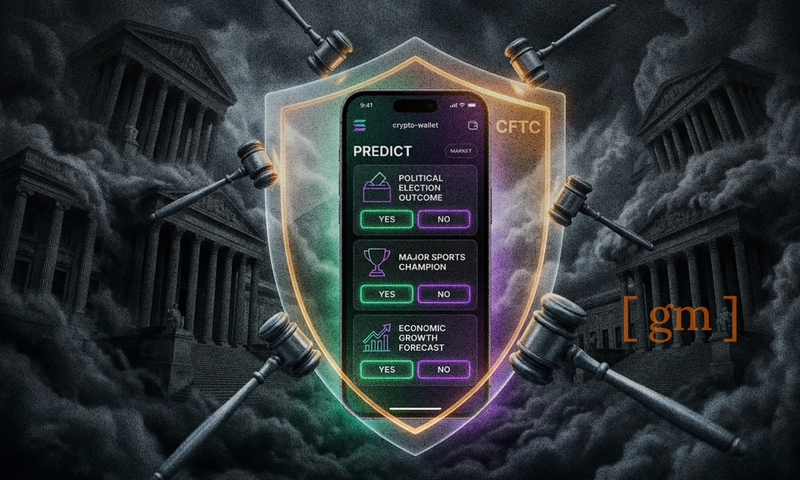
One of crypto's most popular wallets just made a notable bet, on prediction markets, and on who gets to regulate them. Phantom, the leading Solana wallet, began rolling out Kalshi's prediction markets to US users on Friday, letting people trade on real-world events, from elections to sports to the economy, directly inside the app. The twist: Phantom is pushing ahead even as several states sue to block Kalshi, with the company declaring itself "confident and comfortable" wading into one of crypto's hottest legal battles. Here's what launched and why it matters.
What Phantom launched
Starting October 23, Phantom began a staged rollout of Kalshi-powered prediction markets to its US users, expanding gradually over the coming weeks. The mechanics:
- Users trade event contracts, yes/no bets on real-world outcomes, through a "Predict" tab in the Phantom app.
- Trades are funded with CASH, Phantom's dollar-pegged stablecoin, held in a Phantom Cash account. Funds move to Kalshi and are converted to fiat for settlement; winnings return to the user's Cash account.
- Users must complete KYC (identity verification) on Kalshi, which operates the markets, sets the rules, executes trades, and determines outcomes.
- The fee is $0.02 per contract, plus a small network fee.
Kalshi is making its full catalog available, while Phantom chooses which markets to display. This isn't entirely new ground for Phantom, it first integrated Kalshi in December 2025, but this is its first broad US rollout, following CFTC no-action relief it received in March 2026.
The bold part: proceeding despite lawsuits
Here's what makes this more than a routine product launch. Phantom is expanding into prediction markets at the exact moment they're under heavy legal fire. Multiple US states, including New York, have sued Kalshi (and rival Polymarket), arguing their event contracts amount to unlicensed gambling under state law. Kalshi's defense is that it's federally regulated by the CFTC, which it claims preempts state gambling laws.
Phantom is planting its flag firmly on Kalshi's side of that fight. When asked whether the lawsuits concern the company, Phantom's Chief Legal Officer Kevin Jacobs said Phantom believes the CFTC has clear jurisdiction over these products and remains "confident and comfortable" moving forward. That said, Phantom is hedging operationally: it's restricting certain market categories in states with active disputes, blocking sports markets in Michigan; sports, elections, politics, and entertainment in Nevada; and broader categories (including culture, tech, and geopolitics) in Washington. In other words, it's betting on federal authority while complying with state restrictions in the meantime.
The context: a prediction-market boom and turf war
The timing reflects how huge prediction markets have become. Kalshi's trading volume hit roughly $291 billion in 2026, with October alone around $55 billion. Putting that firehose of activity inside a widely-used crypto wallet gives Kalshi a major new distribution channel and gives Phantom users a native way to speculate on events without leaving the app.
But the legal cloud is real and growing. Beyond the state lawsuits, a CME-backed industry group is urging the CFTC to block Kalshi's new oil-futures product, and the Pentagon just barred its personnel from betting on prediction markets with nonpublic information. The entire sector is operating in a contested regulatory space, with the fundamental question, do states or the federal CFTC control prediction markets?, still unresolved in the courts.
Why it matters
Phantom's move is significant on two levels. First, it accelerates the mainstreaming of prediction markets: embedding Kalshi into a major crypto wallet, funded by a stablecoin, makes betting on real-world events as frictionless as any other in-app trade, reaching millions of crypto users directly. Second, it's a vote of confidence in a specific legal outcome, that federal CFTC authority will ultimately override state gambling laws. By proceeding "confident and comfortable" amid active lawsuits, Phantom is effectively wagering that the prediction-market model survives its legal challenges. If it's right, it's early to a booming category. If the states prevail, it's exposed to a patchwork of restrictions or worse. Either way, the launch shows how badly crypto companies want a piece of the prediction-market boom, and how much of the sector's future hinges on a turf war between state and federal regulators that's still playing out. For users, the practical reality: you can now bet on real-world events inside your crypto wallet, in a legal environment that's anything but settled.