
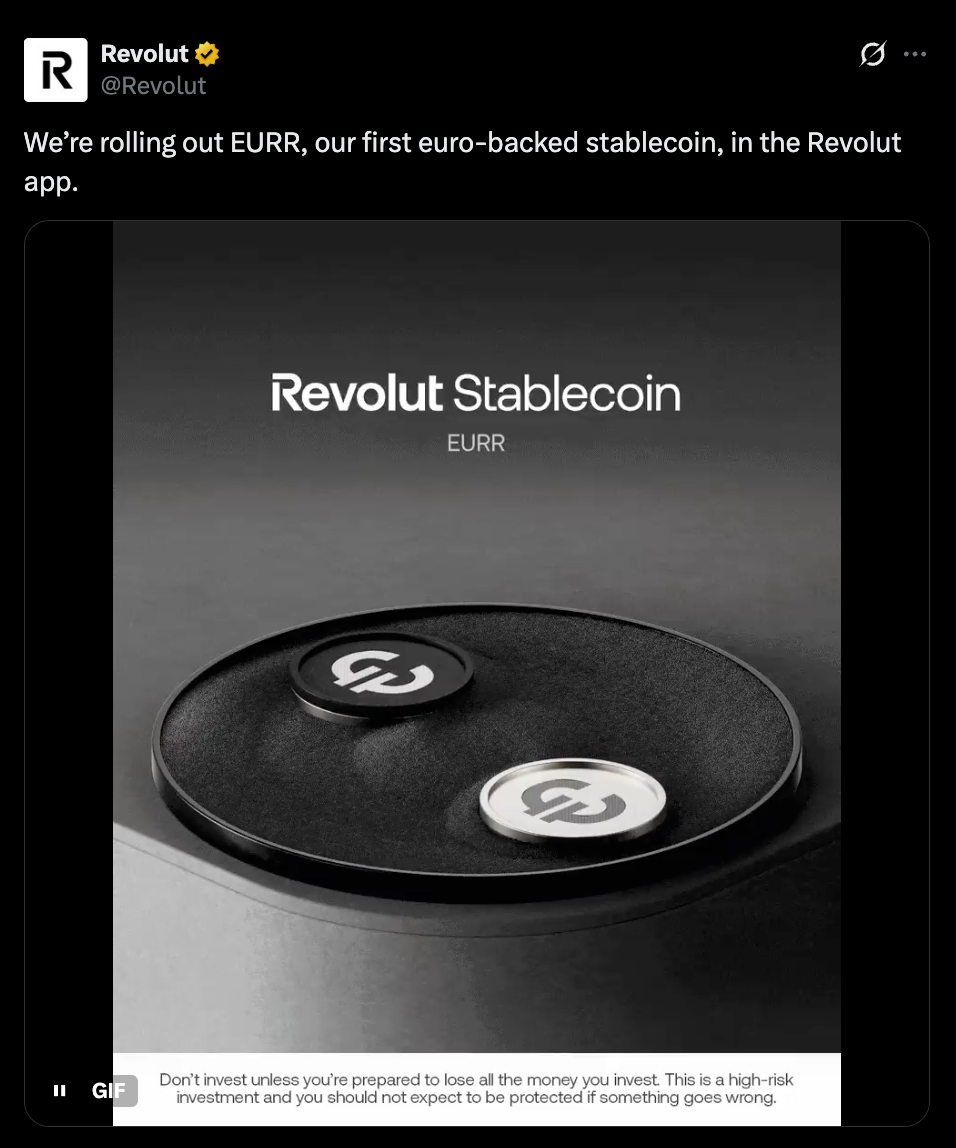
Revolut, the UK fintech giant valued at over $100 billion, has officially entered the stablecoin business. On August 26, the company began a phased rollout of EURR, its first euro-pegged stablecoin, to customers in Denmark, Poland, and Portugal, with the rest of the European Economic Area to follow later this year. It's a move that instantly makes one of Europe's most-used financial apps a serious player in the fast-growing world of digital money, and the way it's structured says a lot about where regulated finance thinks stablecoins are heading.
What EURR actually is
EURR is a digital token designed to hold a stable value of exactly €1.00, redeemable one-to-one for euros inside the Revolut app. It runs on public blockchains including Ethereum and Polygon, meaning it can move outside Revolut's walls to external wallets and exchanges that support it. The pitch to users is simple: instant, near-free movement of euros on-chain, the ability to trade against other crypto assets inside the app, and seamless switching between traditional euros and crypto. As Revolut's head of crypto put it, the goal is to connect its 80 million customers "directly to onchain finance."
The clever part: Revolut brands it, but doesn't issue it
Here's a structural detail that matters. Revolut brands and distributes EURR, but it doesn't legally issue the token. That job falls to Bridge, the stablecoin infrastructure company Stripe acquired for $1.1 billion in early 2025, operating through a Luxembourg entity licensed under the EU's MiCA framework. Bridge manages the reserves and carries the legal redemption obligation, while Revolut handles the customer relationship and distribution.
That division of labor is smart. It lets Revolut offer a fully compliant, MiCA-regulated stablecoin to tens of millions of users without having to build and license the reserve-management machinery itself. It's a template other banks and fintechs are likely to copy: partner with specialized stablecoin infrastructure, keep the customer-facing brand.
The real story: distribution beats everything
The stablecoin market is enormous but lopsided. Dollar-pegged tokens like USDT and USDC together exceed $300 billion, while the entire euro stablecoin category sits under $800 million, less than 0.4% of the total. On paper, Revolut is a tiny new entrant in a niche corner.
But that math misses the point, because Revolut's weapon isn't circulation, it's distribution. The company brings more than 80 million retail customers and over 16 million crypto users to a market where most euro stablecoins struggle for reach. A stablecoin's usefulness scales with how many people and services accept it, and few players on earth can flip on a user base this large overnight. That built-in audience is exactly what the incumbents don't have and can't easily buy.
The Tether angle: compliance as a competitive weapon
Perhaps the most telling part of the timing: Revolut is launching its own euro coin at the same moment it's reportedly moving away from Tether's USDT in Europe, a token that has faced hurdles complying with MiCA's strict rules. The message is unmistakable. Rather than route customers through a dollar stablecoin of uncertain regulatory standing, Revolut is steering them toward a compliant, euro-denominated coin it controls end to end.
This is the same pattern reshaping European crypto across the board: MiCA compliance has become a competitive weapon, not just a legal checkbox. The players who built for the rules, Circle's compliant EURC, Société Générale's EURCV, and now Revolut's EURR, are being handed market share as non-compliant rivals get squeezed out. Revolut is playing that game with the biggest customer base of any of them.
Why it matters
Three reasons this is bigger than one product launch. First, it's a major step in stablecoins going mainstream, when a bank-scale app with 80 million users bakes a stablecoin directly into its interface, digital dollars and euros stop being a crypto-native curiosity and start being a normal payment feature. Second, it's a euro milestone: the stablecoin world is overwhelmingly dollar-denominated, and a serious euro push from a major fintech is exactly what the ECB and European policymakers have wanted to reduce reliance on dollar tokens. Third, it's a preview of Revolut's ambitions, the company has called EURR only "the first step" toward a full suite of stablecoins in multiple currencies, and has signaled stablecoins will feature in its planned US banking offering once its charter application clears.
The competition just changed shape. The question for the rest of the industry is no longer whether mainstream finance will adopt stablecoins, it's who owns the user relationship when they do. Revolut just made a very large claim on that answer.
What to watch: how fast EURR expands across the EEA, whether other neobanks and megabanks follow with their own branded stablecoins, EURR's adoption numbers versus incumbent euro tokens, and whether Revolut's US charter unlocks a dollar version.