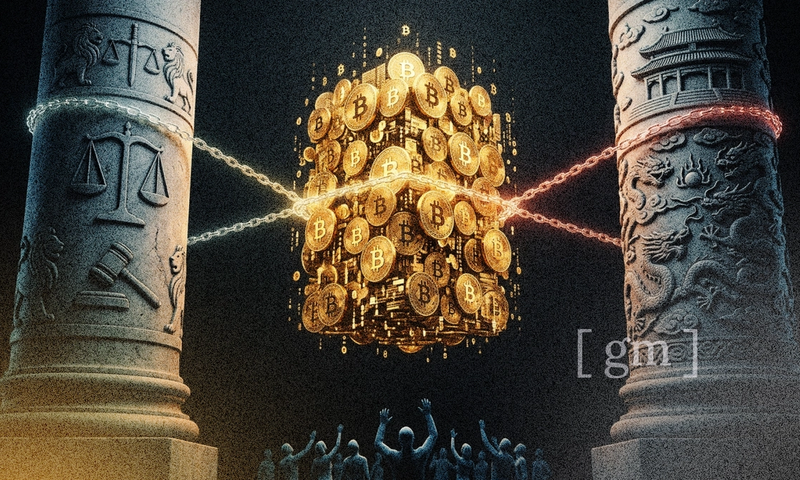
One of the strangest and highest-stakes legal battles in crypto history just took a dramatic turn. A UK High Court has ruled that more than 61,000 Bitcoin, seized in the largest cryptocurrency haul in British history and now worth billions of dollars, must have ownership claims decided under Chinese law rather than UK law. The consequence is stark and unusual: roughly 16,000 Chinese fraud victims may be able to recover only their original money, while the Bitcoin's staggering price gains could end up in the UK Treasury. Here's the extraordinary story behind the ruling.
The background: the "Bitcoin Queen" Ponzi scheme
The case traces back to Qian Zhimin, a Chinese woman dubbed the "Bitcoin Queen." Between 2014 and 2017, she orchestrated a massive Ponzi scheme through her company Tianjin Lantian Gerui ("Blue Sky Greet"), defrauding more than 128,000 investors of roughly 40 billion yuan (about £4.2 billion). Crucially, rather than keeping the stolen money as cash, Qian converted huge amounts of it into Bitcoin on the Huobi exchange starting in 2014, at an average price of around 2,815 yuan per coin.
She then fled China on a forged passport, moved to London, and evaded authorities for years before UK police seized the Bitcoin-laden laptop. Qian was sentenced to 11 years and eight months in November 2025. The seized stash, over 61,000 BTC, became the largest crypto seizure in UK history, and thanks to Bitcoin's rise, a fortune.
The twist: a ~200x appreciation
Here's what makes this case so unusual. Qian bought the Bitcoin cheaply more than a decade ago. Since then, Bitcoin's price has risen roughly 200-fold. The coins she acquired for the equivalent of a few thousand yuan each are now worth around 560,000 yuan apiece. The total seized hoard is valued in the billions of dollars.
That astronomical gain is the heart of the legal fight. The original victims lost a certain amount of money; the Bitcoin those funds became is now worth vastly more. Who is entitled to that appreciation, the victims, or the state that seized it?
What the court actually ruled
On October 12, the UK High Court, via Mr Justice Turner, ruled that the victims' property claims to the Bitcoin must be assessed under Chinese law, not English law. The UK's Director of Public Prosecutions had argued for Chinese law to apply; the investors had pushed for UK law. The investors lost that argument.
Why does the choice of law matter so much? Because the two legal systems treat this situation very differently. Under the interpretation at play, Chinese law would generally limit defrauded investors to recovering their original principal plus interest, not a share of the asset's dramatic appreciation. UK law, the victims argued, might have allowed them to claim a proportional stake in the Bitcoin itself, and thus its gains.
So the ruling means the ~16,000 Chinese victims who registered claims through the UK process may get back only what they put in (plus interest), while the roughly 200x appreciation, worth billions, lacks a clear legal claimant. As analysts have noted, that unclaimed appreciation has a significant chance of flowing into the UK Treasury.
It's not over
Important caveats keep this from being a final verdict. The case remains before the High Court in London (it is not being transferred to China), and the next stage will involve expert evidence on Chinese law to determine whether the victims can establish any ownership interest at all. Mr Justice Turner explicitly left questions about the content and effect of Chinese law for a later hearing. And the victims plan to appeal. So while the jurisdictional ruling is a serious setback for them, the ultimate distribution of the Bitcoin, and its gains, is not yet settled.