What was once dismissed as online gambling is rapidly evolving into a serious financial signal.
Platforms like Polymarket and Kalshi are transforming from niche experiments into tools increasingly watched by Wall Street – and even policymakers at the Federal Reserve.
From Curiosity to Market Signal
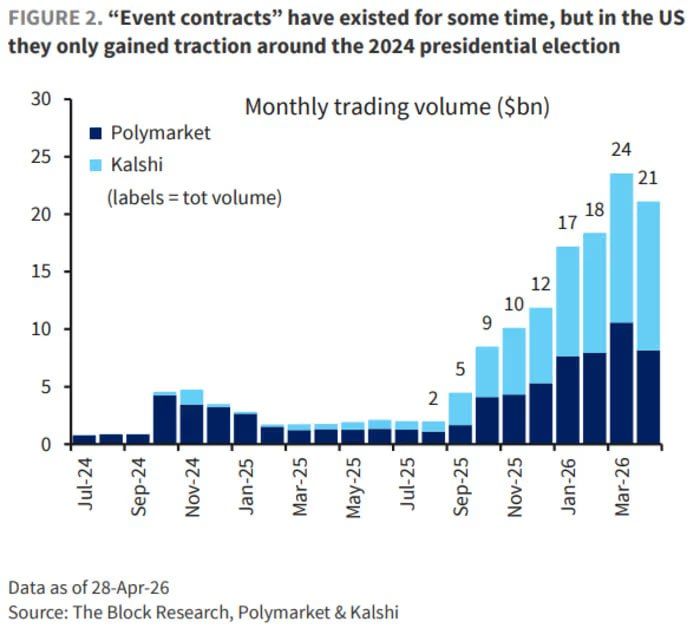
The growth tells the story. Monthly trading volume across prediction markets surged from $5 billion in November 2024 to $24 billion by March 2026, reflecting a sharp rise in participation and liquidity. As these markets deepen, their data is becoming more statistically meaningful — and harder to ignore.
Unlike traditional financial assets, which often move for a mix of overlapping reasons, prediction markets are designed to isolate specific outcomes. Traders aren’t just speculating on price — they are pricing probabilities.
Whether it's:
- an upcoming FOMC rate decision,
- inflation data releases, or
- geopolitical flashpoints like the Strait of Hormuz,
these markets provide a direct, real-time estimate of what participants believe will happen.
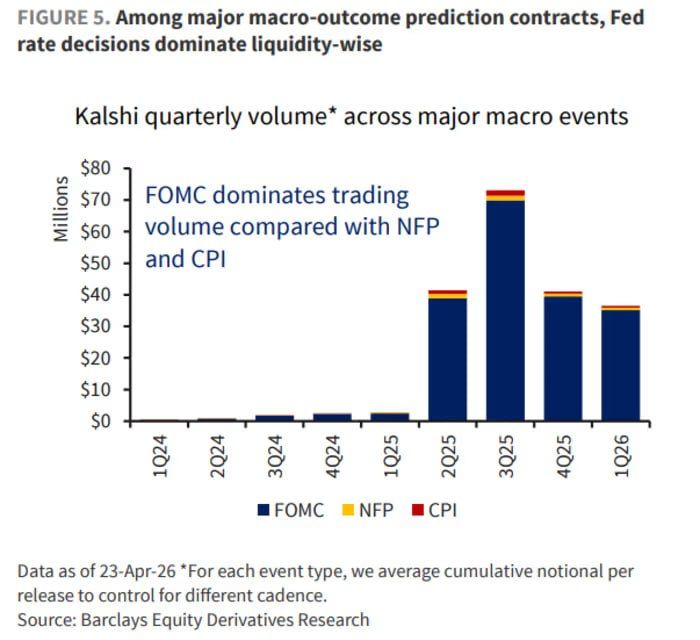
According to analysts at Barclays, prediction market behavior differs significantly from traditional derivatives.
FOMC-related contracts on prediction platforms tend to trade more gradually:
- 50% of volume occurs in the week leading up to a meeting,
- compared to 95% for S&P 500 options.
This suggests that traders are using prediction markets not for last-minute hedging, but for early positioning and structured risk planning around specific macro events.
A New Tool for Policymakers?
The implications extend beyond investors.
A report highlighted by The Economist suggests prediction markets could serve as an “ideal testing ground” for central banks. Supporting this view, research by Federal Reserve economist Anthony Diercks found that Kalshi’s forecasts for interest rates were more accurate than both futures and options markets.
For other indicators:
- Forecasts for unemployment and core inflation aligned with Bloomberg consensus,
- Predictions for headline inflation were even more accurate.
This growing relevance comes at a pivotal moment. The newly appointed Fed Chair, Kevin Warsh, is known for advocating the use of real-time data in policymaking.
That raises a compelling possibility: prediction markets could soon become one of the reference points in how the Federal Reserve interprets market expectations and calibrates its decisions.
Not Gambling Anymore
As liquidity deepens and forecasting accuracy improves, prediction markets are shedding their reputation as speculative side bets.
Instead, they are emerging as:
- information-efficient pricing mechanisms,
- forward-looking economic indicators, and
- potentially, inputs into monetary policy itself.
If current trends continue, the line between “market signal” and “policy tool” may blur faster than expected.