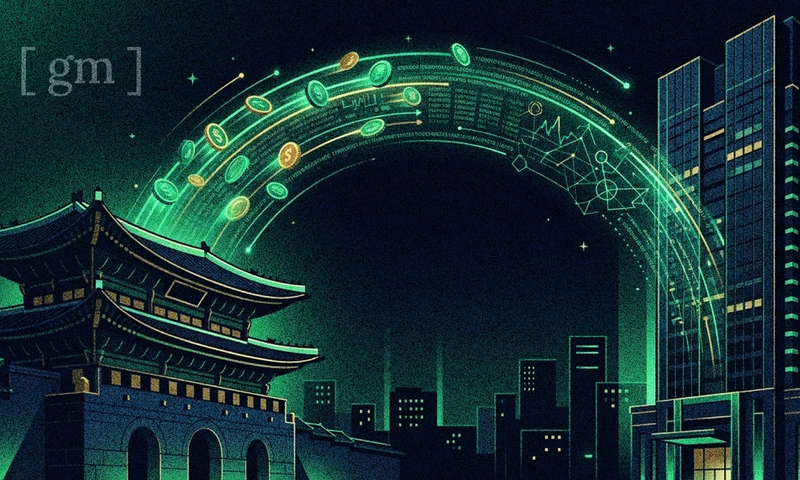
In the space of two days, the two most developed crypto markets in Asia quietly rewrote their legal foundations, and almost nobody connected the dots.
On Tuesday, at a policy briefing at the presidential Blue House, South Korea's Ministry of Economy and Finance announced the National Asset Basic Act, a full replacement of the State Property Act of 1950. The 76-year-old law was written for a state whose wealth was land and buildings; the new one formally adds virtual assets and intellectual property to the definition of what the government owns. It's the first overhaul of the state asset system since the Korean War, covering a portfolio that has grown to more than 1,400 trillion won = roughly $938 billion.
The same day, Japan moved to reclassify crypto as a financial product, shifting it toward the framework that governs securities – complete with insider trading rules. Lawmakers' reasoning: crypto has outgrown its life as a payment method and needs rules built for investment products. The reclassification is also the legal key to the reform Japan's industry has chased for years taxing crypto gains like stock gains at a flat rate, instead of as miscellaneous income at progressive rates that can climb far higher.
Look at what Korea is actually building. This isn't a monitoring regime. The plan includes a tokenized government bond pilot in 2027 running on the Bank of Korea's CBDC infrastructure, security-token offerings of state-owned real estate with returns shared with the public, and from February 2027, formal recognition of blockchain ledgers as security registries under the Capital Markets Act. In parallel, Seoul is drafting stablecoin rules and reviewing amendments to allow spot crypto ETFs. For a country that handles an estimated 15-20% of global crypto trading volume with over 18 million participants, the state's balance sheet is being taught to speak the market's language.
The irony inside the Korea story: the government can modernize its own ledgers faster than it can regulate the private market. The Digital Asset Basic Act — the comprehensive framework for exchanges, issuers and won-pegged stablecoins — remains stuck, with the Financial Services Commission and the central bank still fighting over who licenses stablecoin issuers. Korean traders also still face a planned 22% tax on crypto gains above 2.5 million won from 2027, while stock profits stay exempt — a gap a 50,000-signature petition has failed to reopen. Integration is coming to the state first, citizens second.
The pattern, and who's missing it. Put the two moves together and the philosophy is identical: crypto is an asset class to be integrated – into tax codes, securities law, even the sovereign balance sheet – not a fad to be contained. Now widen the lens. The EU shipped its framework in 2024 and is in enforcement mode as MiCA's transitional period winds down. Asia is now building the next layer: state tokenization, competitive tax treatment, insider-trading rules. And the United States? Tomorrow, the House holds a field hearing in New York on the CLARITY Act – a bill that passed the House a year ago and now sits with roughly 43% odds of becoming law this year. Three regions, three speeds: Europe regulated it, Asia is institutionalizing it, America is still holding hearings about it.
Why Europe should care: the competition just moved past "who has rules" to "who has the better ones." Japan's flat-tax direction and Korea's sovereign tokenization pilots are exactly the benchmarks European and CEE finance ministries will be measured against – including in countries like Ukraine, where crypto tax design is still an open fight. Having MiCA first mover status is worth less if Asia makes holding and building there cheaper.
What's next: Korea's public-private task force drafting the new act's scope, Japan's tax reform timeline, and the February 2027 ledger-recognition date, the moment tokenized instruments in Korea gain the same legal standing as traditional registries.