Robinhood launched its own blockchain to bring Wall Street on-chain, letting people trade tokenized versions of real stocks like Apple, Nvidia, and Tesla 24/7. Two months in, the network is a runaway success by almost every metric, except the one it was built for. The dominant activity isn't tokenized stocks at all. It's memecoins.

What Robinhood Chain is
Robinhood Chain is an Ethereum-compatible Layer-2 network built on Arbitrum's technology stack, which went live on July 1, 2026. The pitch: a blockchain purpose-built for tokenized real-world assets, especially US equities, offering round-the-clock trading and self-custody. Each stock token is a wrapper representing a real share held in custody by a US broker-dealer, so owning the token gives you price exposure, not the actual share. Robinhood has expanded the catalog from 200+ names at launch to over 2,000 tokenized stocks and ETFs, available to users across the EU and EEA.
The milestones are genuinely impressive
By raw numbers, the chain is thriving. Its total value locked has surpassed $1 billion, with DEX volume nearing $1 billion within two months. On August 30, it processed a record 5.52 million transactions in a single day, with roughly $875 million in DEX trading, and apps on the chain earned about $2.66 million in fees over 24 hours, enough that Robinhood Chain out-earned Ethereum in daily revenue on its busiest days. For a two-month-old network, that's an extraordinary ramp.
But here's the twist: it's memecoins, not stocks
Peel back the numbers and the picture changes. Of that record-breaking activity, memecoin tools and Uniswap generated about 88% of the fees. On its busiest day, users launched around 22,600 new tokens in 24 hours, overwhelmingly speculative memecoins. Meanwhile, the tokenized real-world assets the chain was built for were worth only about $12.8 million, including $10.7 million of stocks, a rounding error next to the memecoin and stablecoin flows dominating the network.
In other words, Robinhood built a serious piece of financial infrastructure, and the crowd showed up to gamble on memecoins instead. It's a pattern crypto has seen before: speculative activity is simply stickier and higher-volume than the "real" use case, at least early on.
PONS: the launchpad powering the frenzy
At the center of the memecoin boom is PONS, a non-custodial, permissionless token launchpad that lets anyone deploy a token in minutes with no coding, essentially Robinhood Chain's answer to Solana's Pump.fun. It's become the chain's dominant launchpad, generating over $116 million in volume and 1.68 million trades in its first weeks, with more than 50,000 tokens launched through it.
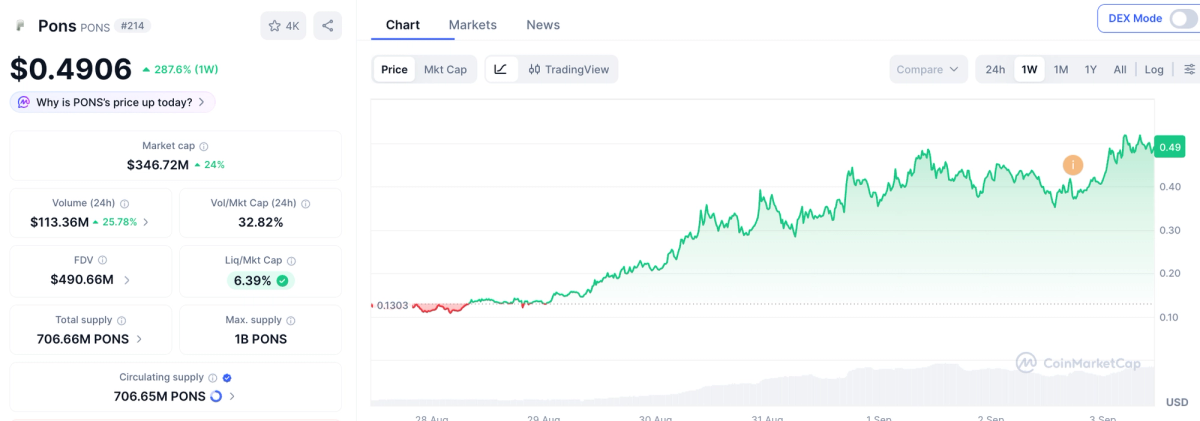
The PONS token itself has been on a tear, ripping more than 1,100% from its launch-week lows to briefly touch an all-time high near $0.049, driven by fee-based buybacks that have burned a chunk of its supply. Notably, PONS has also leaned into the chain's original purpose: its V2 upgrade added Uniswap V4 integration allowing new tokens to be paired directly with tokenized stocks, not just ETH, a genuine bridge between the memecoin casino and the real-world-asset vision.
Why it matters
Robinhood Chain is a fascinating case study in the gap between what infrastructure is designed for and what people actually use it for. The tokenized-stock thesis, trading Apple or Nvidia on-chain, is real and growing (the broader tokenized-stock market crossed $1 billion in 2025 and keeps expanding), but it's a slow, institutional-paced build. Memecoin speculation is fast, viral, and fee-rich, so it dominated first. For Robinhood, the memecoin frenzy is a double-edged sword: it drives massive revenue and proves the chain works at scale, but it's not the sober, Wall-Street-on-chain narrative the company pitched. The real question is whether that speculative energy eventually funnels users toward the tokenized-stock product, or whether the casino simply stays the main event.